


Page 806 - Atlas of Creation Volume 1
P. 806
come up with a probability of 1 in 2     400 , or 10 120 . Just for a comparison, let us remember that the number of elec-
                  trons in the universe is estimated at 10 , which although vast, is a much smaller number. The probability of
                                                               79
                  these amino acids forming the required sequence and functional form would generate much larger numbers. If
                  we add these probabilities to each other, and if we go on to work out the probabilities of even higher numbers

                  and types of proteins, the calculations become inconceivable.

                       Correct Bond is Vital


                       The difficulties the theory of evolution is unable to overcome with regard to the development of a single
                                                                                          protein are not limited to those we have re-
                                                                                          counted so far. It is not enough for amino acids

                                                                                          to be arranged in the correct numbers, se-
                                                                                          quences, and required three-dimensional struc-
                                                                                          tures. The formation of a protein also requires
                                                                                          that amino acid molecules with more than one
                                                                                          arm be linked to each other only in certain

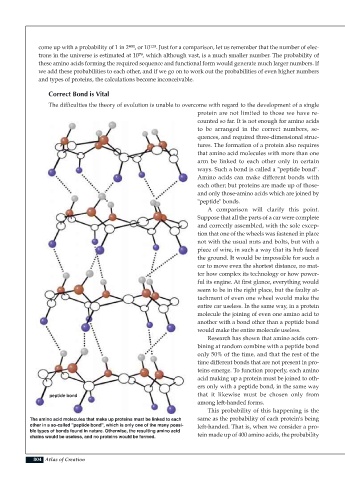
                                                                                          ways. Such a bond is called a "peptide bond".
                                                                                          Amino acids can make different bonds with
                                                                                          each other; but proteins are made up of those-

                                                                                          and only those-amino acids which are joined by
                                                                                          "peptide" bonds.
                                                                                              A comparison will clarify this point.
                                                                                          Suppose that all the parts of a car were complete
                                                                                          and correctly assembled, with the sole excep-

                                                                                          tion that one of the wheels was fastened in place
                                                                                          not with the usual nuts and bolts, but with a
                                                                                          piece of wire, in such a way that its hub faced

                                                                                          the ground. It would be impossible for such a
                                                                                          car to move even the shortest distance, no mat-
                                                                                          ter how complex its technology or how power-
                                                                                          ful its engine. At first glance, everything would
                                                                                          seem to be in the right place, but the faulty at-

                                                                                          tachment of even one wheel would make the
                                                                                          entire car useless. In the same way, in a protein
                                                                                          molecule the joining of even one amino acid to

                                                                                          another with a bond other than a peptide bond
                                                                                          would make the entire molecule useless.
                                                                                              Research has shown that amino acids com-
                                                                                          bining at random combine with a peptide bond
                                                                                          only 50% of the time, and that the rest of the

                                                                                          time different bonds that are not present in pro-
                                                                                          teins emerge. To function properly, each amino
                                                                                          acid making up a protein must be joined to oth-

                                                                                          ers only with a peptide bond, in the same way
                       peptide bond                                                       that it likewise must be chosen only from
                                                                                          among left-handed forms.
                                                                                              This probability of this happening is the

              The amino acid molecules that make up proteins must be linked to each       same as the probability of each protein's being
              other in a so-called "peptide bond", which is only one of the many possi-   left-handed. That is, when we consider a pro-
              ble types of bonds found in nature. Otherwise, the resulting amino acid
              chains would be useless, and no proteins would be formed.                   tein made up of 400 amino acids, the probability


                804 Atlas of Creation

