


Page 805 - Atlas of Creation Volume 1
P. 805
Harun Yahya


             been revealed by research is that all the proteins in plants and animals on this planet, from the simplest or-
             ganism to the most complex, are made up of left-handed amino acids. If even a single right-handed amino
             acid gets attached to the structure of a protein, the protein is rendered useless. In a series of experiments, sur-

             prisingly, bacteria that were exposed to right-handed amino acids immediately destroyed them. In some
             cases, they produced usable left-handed amino acids from the fractured components.
                 Let us for an instant suppose that life came about by chance as evolutionists claim it did. In this case, the
             right- and left-handed amino acids that were generated by chance should be present in roughly equal pro-
             portions in nature. Therefore, all living things should have both right- and left-handed amino acids in their

             constitution, because chemically it is possible for amino acids of both types to combine with each other.
             However, as we know, in the real world the proteins existing in all living organisms are made up only of left-
             handed amino acids.

                 The question of how proteins can pick out only the left-handed ones from among all amino acids, and
             how not even a single right-handed amino acid gets involved in the life process, is a problem that still baffles
             evolutionists. Such a specific and conscious selection constitutes one of the greatest impasses facing the the-
             ory of evolution.
                 Moreover, this characteristic of proteins makes the problem facing evolutionists with respect to "coinci-

             dence" even worse. In order for a "meaningful" protein to be generated, it is not enough for the amino acids
             to be present in a particular number and sequence, and to be combined together in the right three-dimen-
             sional design. Additionally, all these amino acids have to be left-handed: not even one of them can be right-

             handed. Yet there is no natural selection mechanism which can identify that a right-handed amino acid has
             been added to the sequence and recognise that it must therefore be removed from the chain. This situation
             once more eliminates for good the possibility of coincidence and chance.
                 The Brittanica Science Encyclopaedia, which is an outspoken defender of evolution, states that the amino
             acids of all the living organisms on earth, and the building blocks of complex polymers such as proteins,

             have the same left-handed asymmetry. It adds that this is tantamount to tossing a coin a million times and al-
             ways getting heads. The same encyclopaedia states that it is impossible to understand why molecules be-
             come left-handed or right-handed, and that this choice is fascinatingly related to the origin of life on earth.         114

                 If a coin always turns up heads when tossed a million times, is it more logical to attribute that to chance,
             or else to accept that there is conscious intervention going on? The answer should be obvious. However, ob-
             vious though it may be, evolutionists still take refuge in coincidence, simply because they do not want to ac-
             cept the existence of "conscious intervention".
                 A situation similar to the left-handedness of amino acids also exists with respect to nucleotides, the

             smallest units of the nucleic acids, DNA and RNA. In contrast to proteins, in which only left-handed amino
             acids are chosen, in the case of the nucleic acids, the preferred forms of their nucleotide components are al-
             ways right-handed. This is another fact that can never be explained by coincidence.

                                                                                   In conclusion, it is proven beyond a shadow of
                                                                               doubt by the probabilities we have examined that
                                                                               the origin of life cannot be explained by chance. If
                                                                               we attempt to calculate the probability of an aver-
                                                                             age-sized protein consisting of 400 amino acids

                                                                           being selected only from left-handed amino acids, we


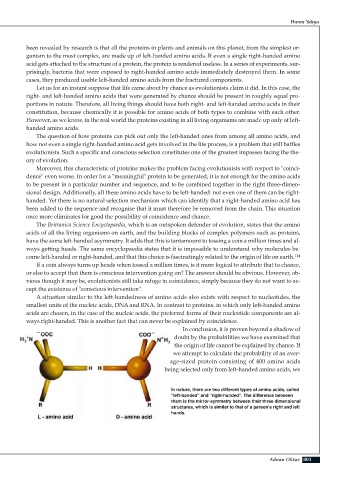
                                                                              In nature, there are two different types of amino acids, called
                                                                              "left-handed" and "right-handed". The difference between
                                                                              them is the mirror-symmetry between their three dimensional
                                                                              structures, which is similar to that of a person's right and left
                                                                              hands.


                                                                                                                          Adnan Oktar    803

