


Page 800 - Atlas of Creation Volume 1
P. 800
The Miracle in the Cell and the End of Evolution


                       The complex structure of the living cell was unknown in Darwin's day and at the time, ascribing life to "co-
                  incidences and natural conditions" was thought by evolutionists to be convincing enough.
                       The technology of the 20th century has delved into the tiniest particles of life and has revealed that the cell
                  is the most complex system mankind has ever confronted. Today we know that the cell contains power stations

                  producing the energy to be used by the cell, factories manufacturing the enzymes and hormones essential for
                  life, a databank where all the necessary information about all products to be produced is recorded, complex
                  transportation systems and pipelines for carrying raw materials and products from one place to another, ad-

                  vanced laboratories and refineries for breaking down external raw materials into their useable parts, and spe-
                  cialised cell membrane proteins to control the incoming and outgoing materials. And these constitute only a
                  small part of this incredibly complex system.
                       W. H. Thorpe, an evolutionist scientist, acknowledges that "The most elementary type of cell constitutes a
                  'mechanism' unimaginably more complex than any machine yet thought up, let alone constructed, by

                  man."  105
                       A cell is so complex that even the high level of technology attained today cannot produce one. No effort to
                  create an artificial cell has ever met with success. Indeed, all attempts to do so have been abandoned.

                       The theory of evolution claims that this system-which mankind, with all the intelligence, knowledge and
                  technology at its disposal, cannot succeed in reproducing-came into existence "by chance" under the conditions
                  of the primordial earth. To give another example, the probability of forming of a cell by chance is about the
                  same as that of producing a perfect copy of a book following an explosion in a printing-house.
                       The English mathematician and astronomer Sir Fred Hoyle made a similar comparison in an interview

                  published in Nature magazine on November 12, 1981. Although an evolutionist himself, Hoyle stated that the
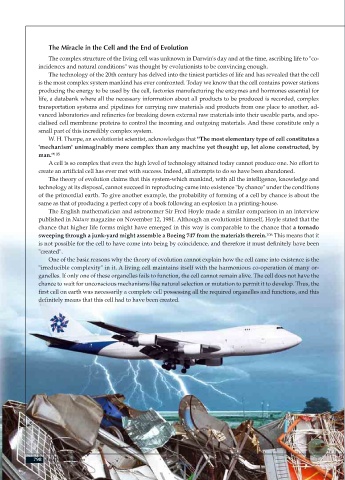
                  chance that higher life forms might have emerged in this way is comparable to the chance that a tornado
                  sweeping through a junk-yard might assemble a Boeing 747 from the materials therein.                   106  This means that it

                  is not possible for the cell to have come into being by coincidence, and therefore it must definitely have been
                  "created".
                       One of the basic reasons why the theory of evolution cannot explain how the cell came into existence is the
                  "irreducible complexity" in it. A living cell maintains itself with the harmonious co-operation of many or-
                  ganelles. If only one of these organelles fails to function, the cell cannot remain alive. The cell does not have the

                  chance to wait for unconscious mechanisms like natural selection or mutation to permit it to develop. Thus, the
                  first cell on earth was necessarily a complete cell possessing all the required organelles and functions, and this
                  definitely means that this cell had to have been created.


                798 Atlas of Creation

