


Page 795 - Atlas of Creation Volume 1
P. 795
Harun Yahya


                 Human beings walk upright on two feet. This is a very special form of locomotion
             not seen in any other mammalian species. Some other animals do have a limited ability
             to move when they stand on their two hind feet. Animals like bears and monkeys can

             move in this way only rarely, such as when they want to reach a source of food, and
             even then only for a short time. Normally, their skeletons lean forward and they walk
             on all fours.
                 Well, then, has bipedalism evolved from the quadrupedal gait of apes, as evo-
             lutionists claim?

                 Of course not. Research has shown that the evolution of bipedalism never oc-
             curred, nor is it possible for it to have done so. First of all, bipedalism is not an
             evolutionary advantage. The way in which monkeys move is much easier, faster,

             and more efficient than man's bipedal stride. Man can neither move by jumping
             from tree to tree without descending to the ground, like a chimpanzee, nor run at a
             speed of 125 km per hour, like a cheetah. On the contrary, since man walks on two
             feet, he moves much more slowly on the ground. For the same reason, he is one of
             the most unprotected of all species in nature in terms of movement and defence.

             According to the logic of the theory of evolution, monkeys should not have
             evolved to adopt a bipedal stride; humans should instead have evolved to be-
             come quadrupedal.

                 Another impasse of the evolutionary claim is that bipedalism does not
             serve the "gradual development" model of Darwinism. This model, which
             constitutes the basis of evolution, requires that there should be a "compound"
             stride between bipedalism and quadrupedalism. However, with the computerised
             research he conducted in 1996, the English paleoanthropologist Robin Crompton,

             showed that such a "compound" stride was not possible. Crompton reached the fol-
                                                                                                  99
             lowing conclusion: A living being can either walk upright, or on all fours. A type
             of stride between the two is impossible because it would involve excessive energy

             consumption. This is why a half-bipedal being cannot exist.
                 The immense gap between man and ape is not limited solely to bipedalism.
             Many other issues still remain unexplained, such as brain capacity, the ability to
             talk, and so on. Elaine Morgan, an evolutionist paleoanthropologist, makes the fol-
             lowing confession in relation to this matter:
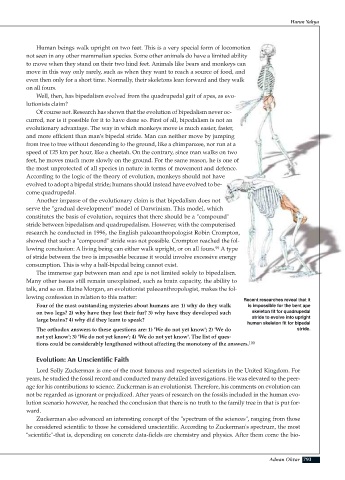
                                                                                                              Recent researches reveal that it
                 Four of the most outstanding mysteries about humans are: 1) why do they walk                   is impossible for the bent ape
                 on two legs? 2) why have they lost their fur? 3) why have they developed such                    skeleton fit for quadrupedal
                                                                                                                  stride to evolve into upright
                 large brains? 4) why did they learn to speak?
                                                                                                                human skeleton fit for bipedal
                 The orthodox answers to these questions are: 1) 'We do not yet know'; 2) 'We do                                      stride.
                 not yet know'; 3) 'We do not yet know'; 4) 'We do not yet know'. The list of ques-
                 tions could be considerably lengthened without affecting the monotony of the answers.           100


                 Evolution: An Unscientific Faith

                 Lord Solly Zuckerman is one of the most famous and respected scientists in the United Kingdom. For
             years, he studied the fossil record and conducted many detailed investigations. He was elevated to the peer-

             age for his contributions to science. Zuckerman is an evolutionist. Therefore, his comments on evolution can
             not be regarded as ignorant or prejudiced. After years of research on the fossils included in the human evo-
             lution scenario however, he reached the conclusion that there is no truth to the family tree in that is put for-
             ward.
                 Zuckerman also advanced an interesting concept of the "spectrum of the sciences", ranging from those

             he considered scientific to those he considered unscientific. According to Zuckerman's spectrum, the most
             "scientific"-that is, depending on concrete data-fields are chemistry and physics. After them come the bio-


                                                                                                                          Adnan Oktar    793

