


Page 792 - Atlas of Creation Volume 1
P. 792
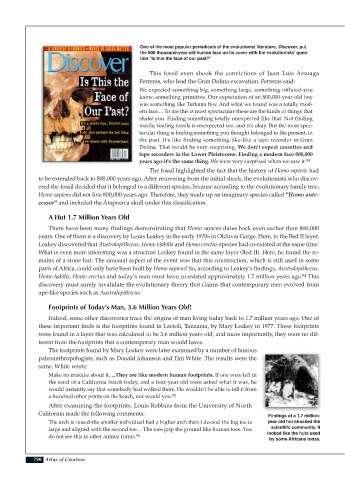
One of the most popular periodicals of the evolutionist literature, Discover, put
                                                                the 800 thousand-year-old human face on its cover with the evolutionists' ques-
                                                                tion "Is this the face of our past?"


                                                                    This fossil even shook the convictions of Juan Luis  Arsuaga
                                                                Ferreras, who lead the Gran Dolina excavation. Ferreras said:
                                                                We expected something big, something large, something inflated-you
                                                                know, something primitive. Our expectation of an 800,000-year-old boy
                                                                was something like Turkana Boy. And what we found was a totally mod-
                                                                ern face.... To me this is most spectacular-these are the kinds of things that
                                                                shake you. Finding something totally unexpected like that. Not finding
                                                                fossils; finding fossils is unexpected too, and it's okay. But the most spec-
                                                                tacular thing is finding something you thought belonged to the present, in
                                                                the past. It's like finding something like-like a tape recorder in Gran
                                                                Dolina. That would be very surprising. We don't expect cassettes and
                                                                tape recorders in the Lower Pleistocene. Finding a modern face 800,000
                                                                years ago-it's the same thing. We were very surprised when we saw it.     93

                                                                    The fossil highlighted the fact that the history of Homo sapiens had
                  to be extended back to 800,000 years ago. After recovering from the initial shock, the evolutionists who discov-

                  ered the fossil decided that it belonged to a different species, because according to the evolutionary family tree,
                  Homo sapiens did not live 800,000 years ago. Therefore, they made up an imaginary species called "Homo ante-
                  cessor" and included the Atapuerca skull under this classification.


                       A Hut 1.7 Million Years Old

                       There have been many findings demonstrating that Homo sapiens dates back even earlier than 800,000

                  years. One of them is a discovery by Louis Leakey in the early 1970s in Olduvai Gorge. Here, in the Bed II layer,
                  Leakey discovered that Australopithecus, Homo Habilis and Homo erectus species had co-existed at the same time.
                  What is even more interesting was a structure Leakey found in the same layer (Bed II). Here, he found the re-
                  mains of a stone hut. The unusual aspect of the event was that this construction, which is still used in some
                  parts of Africa, could only have been built by Homo sapiens! So, according to Leakey's findings, Australopithecus,

                  Homo habilis, Homo erectus and today’s man must have co-existed approximately 1.7 million years ago. This
                                                                                                                                         94
                  discovery must surely invalidate the evolutionary theory that claims that contemporary men evolved from
                  ape-like species such as Australopithecus.


                       Footprints of Today’s Man, 3.6 Million Years Old!

                       Indeed, some other discoveries trace the origins of man living today back to 1.7 million years ago. One of

                  these important finds is the footprints found in Laetoli, Tanzania, by Mary Leakey in 1977. These footprints
                  were found in a layer that was calculated to be 3.6 million years old, and more importantly, they were no dif-
                  ferent from the footprints that a contemporary man would leave.
                       The footprints found by Mary Leakey were later examined by a number of famous

                  paleoanthropologists, such as Donald Johanson and Tim White. The results were the
                  same. White wrote:
                       Make no mistake about it, ...They are like modern human footprints. If one were left in
                       the sand of a California beach today, and a four-year old were asked what it was, he
                       would instantly say that somebody had walked there. He wouldn't be able to tell it from
                       a hundred other prints on the beach, nor would you.    95

                       After examining the footprints, Louis Robbins from the University of North
                  California made the following comments:                                                                Findings of a 1.7 million-

                       The arch is raised-the smaller individual had a higher arch than I do-and the big toe is          year-old hut shocked the
                                                                                                                           scientific community. It
                       large and aligned with the second toe… The toes grip the ground like human toes. You
                                                                                                                         looked like the huts used
                       do not see this in other animal forms. 96
                                                                                                                          by some Africans today.


                790 Atlas of Creation

