


Page 791 - Atlas of Creation Volume 1
P. 791
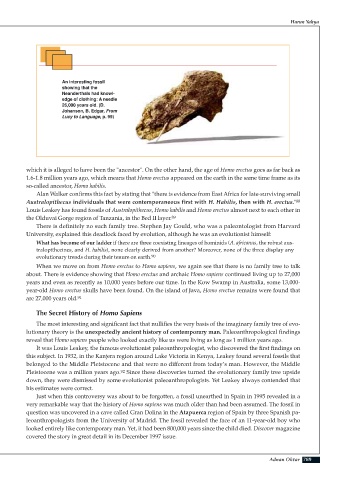
26,000 YEAR OLD NEEDLE:


                                                                                                                                   Harun Yahya


                             An interesting fossil
                             showing that the
                             Neanderthals had knowl-
                             edge of clothing: A needle
                             26,000 years old. (D.
                             Johanson, B. Edgar, From
                             Lucy to Language, p. 99)


             which it is alleged to have been the "ancestor". On the other hand, the age of Homo erectus goes as far back as
             1.6-1.8 million years ago, which means that Homo erectus appeared on the earth in the same time frame as its
             so-called ancestor, Homo habilis.

                 Alan Walker confirms this fact by stating that "there is evidence from East Africa for late-surviving small
             Australopithecus individuals that were contemporaneous first with H. Habilis, then with H. erectus."                     88
             Louis Leakey has found fossils of Australopithecus, Homo habilis and Homo erectus almost next to each other in
             the Olduvai Gorge region of Tanzania, in the Bed II layer.       89

                 There is definitely no such family tree. Stephen Jay Gould, who was a paleontologist from Harvard
             University, explained this deadlock faced by evolution, although he was an evolutionist himself:
                 What has become of our ladder if there are three coexisting lineages of hominids (A. africanus, the robust aus-
                 tralopithecines, and H. habilis), none clearly derived from another? Moreover, none of the three display any
                 evolutionary trends during their tenure on earth.   90

                 When we move on from Homo erectus to Homo sapiens, we again see that there is no family tree to talk
             about. There is evidence showing that Homo erectus and archaic Homo sapiens continued living up to 27,000
             years and even as recently as 10,000 years before our time. In the Kow Swamp in Australia, some 13,000-

             year-old Homo erectus skulls have been found. On the island of Java, Homo erectus remains were found that
             are 27,000 years old.  91


                 The Secret History of Homo Sapiens

                 The most interesting and significant fact that nullifies the very basis of the imaginary family tree of evo-
             lutionary theory is the unexpectedly ancient history of contemporary man. Paleoanthropological findings
             reveal that Homo sapiens people who looked exactly like us were living as long as 1 million years ago.

                 It was Louis Leakey, the famous evolutionist paleoanthropologist, who discovered the first findings on
             this subject. In 1932, in the Kanjera region around Lake Victoria in Kenya, Leakey found several fossils that
             belonged to the Middle Pleistocene and that were no different from today’s man. However, the Middle

             Pleistocene was a million years ago.      92  Since these discoveries turned the evolutionary family tree upside
             down, they were dismissed by some evolutionist paleoanthropologists. Yet Leakey always contended that
             his estimates were correct.
                 Just when this controversy was about to be forgotten, a fossil unearthed in Spain in 1995 revealed in a
             very remarkable way that the history of Homo sapiens was much older than had been assumed. The fossil in

             question was uncovered in a cave called Gran Dolina in the Atapuerca region of Spain by three Spanish pa-
             leoanthropologists from the University of Madrid. The fossil revealed the face of an 11-year-old boy who
             looked entirely like contemporary man. Yet, it had been 800,000 years since the child died. Discover magazine

             covered the story in great detail in its December 1997 issue.


                                                                                                                          Adnan Oktar    789

