


Page 786 - Atlas of Creation Volume 1
P. 786
The primary reason for evolutionists' defining Homo erectus as "primitive", is the cranial capacity of its skull
                  (900-1,100 cc), which is smaller than the average today’s man, and its thick eyebrow projections. However,
                  there are many people living today in the world who have the same cranial capacity as Homo erectus (pyg-
                  mies, for instance) and other races have protruding eyebrows (Native Australians, for instance).

                       It is a commonly agreed-upon fact that differences in cranial capacity do not necessarily denote differences
                  in intelligence or abilities. Intelligence depends on the internal organisation of the brain, rather than on its vol-
                  ume.  81
                       The fossils that have made Homo erectus known to the entire world are those of Peking man and Java man

                  in Asia. However, in time it was realised that these two fossils are not reliable. Peking Man consists of some el-
                  ements made of plaster whose originals have been lost, and Java Man is "composed" of a skull fragment plus a
                  pelvic bone that was found metres away from it with no indication that these belonged to the same creature.
                  This is why the Homo erectus fossils found in Africa have gained such increasing importance. (It should also be
                  noted that some of the fossils said to be Homo erectus were included under a second species named "Homo er-

                  gaster" by some evolutionists. There is disagreement among the experts on this issue. We will treat all these fos-
                  sils under the classification of Homo erectus)
                       The most famous of the Homo erectus specimens found in Africa is the fossil of "Narikotome Homo erectus" or

                  the "Turkana Boy" which was found near Lake Turkana in Kenya. It is confirmed that the fossil was that of a 12-
                  year-old boy, who would have been 1.83 meters tall in adolescence. The upright skeletal structure of the fossil
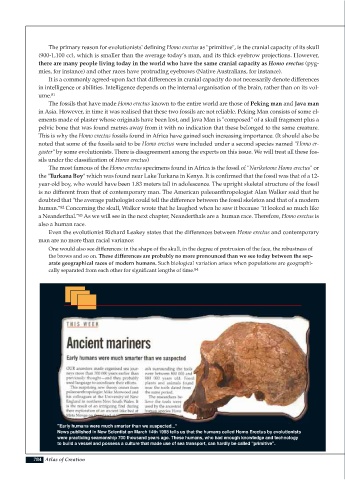
                                                        700 Thousand Y ear Old Mariners
                  is no different from that of contemporary man. The American paleoanthropologist Alan Walker said that he
                  doubted that "the average pathologist could tell the difference between the fossil skeleton and that of a modern

                            82
                  human." Concerning the skull, Walker wrote that he laughed when he saw it because "it looked so much like
                                    83
                  a Neanderthal." As we will see in the next chapter, Neanderthals are a  human race. Therefore, Homo erectus is
                  also a human race.
                       Even the evolutionist Richard Leakey states that the differences between Homo erectus and contemporary

                  man are no more than racial variance:
                       One would also see differences: in the shape of the skull, in the degree of protrusion of the face, the robustness of
                       the brows and so on. These differences are probably no more pronounced than we see today between the sep-
                       arate geographical races of modern humans. Such biological variation arises when populations are geographi-
                       cally separated from each other for significant lengths of time. 84


                           "Early humans were much smarter than we suspected..."
                           News published in New Scientist on March 14th 1998 tells us that the humans called Homo Erectus by evolutionists
                           were practicing seamanship 700 thousand years ago. These humans, who had enough knowledge and technology
                           to build a vessel and possess a culture that made use of sea transport, can hardly be called "primitive".


                784 Atlas of Creation

