


Page 788 - Atlas of Creation Volume 1
P. 788
Professor William Laughlin from the University of Connecticut made extensive anatomi-
                                     cal examinations of Inuits and the people living on the Aleut islands, and noticed that these
                                    people were extraordinarily similar to Homo erectus. The conclusion Laughlin arrived at was
                                   that all these distinct races were in fact different races of Homo sapiens (today’s man).

                                 When we consider the vast differences that exist between remote groups such as Eskimos and
                                 Bushmen, who are known to belong to the single species of Homo sapiens, it seems justifiable to
                                 conclude that Sinanthropus [an erectus specimen] belongs within this same diverse species.         85
                                    It is now a more pronounced fact in the scientific community that Homo erectus is a superfluous
                             taxon, and that fossils assigned to the Homo erectus class are actually not so different from Homo sapi-

                           ens as to be considered a different species. In American Scientist, the discussions over this issue and the
                         result of a conference held on the subject in 2000 were summarised in this way:

                       Most of the participants at the Senckenberg conference got drawn into a flaming debate over the taxonomic sta-
                       tus of Homo erectus started by Milford Wolpoff of the University of Michigan, Alan Thorne of the University of
                       Canberra and their colleagues. They argued forcefully that Homo erectus had no validity as a species and should
                       be eliminated altogether. All members of the genus Homo, from about 2 million years ago to the present, were one
                       highly variable, widely spread species, Homo sapiens, with no natural breaks or subdivisions. The subject of the
                       conference, Homo erectus didn't exist. 86
                       The conclusion reached by the scientists defending the abovementioned thesis can be summarised as
                  "Homo erectus is not a different species from Homo sapiens, but rather a race within Homo sapiens".
                                                                                   On the other hand, there is a huge gap between Homo
                                                                                erectus, a human race, and the apes that preceded Homo

                                                                                 erectus
                                                                                            in the "human evolution" scenario,
                                        FALSE                                     (Australopithecus, Homo Habilis, and Homo rudolfensis).
                                        FALSE
                                                                                  This means that the first men appeared in the fossil
                                                                                 record suddenly and without any prior evolutionary
                                                                                history. This is a most clear indication of their being cre-
                                                                            ated.
                                                                                  Yet, admitting this fact is totally against the dogmatic

                                                                               philosophy and ideology of evolutionists. As a result,
                                                                                 they try to portray Homo erectus, a truly human race, as
                                                                                   a half-ape creature. In their Homo erectus reconstruc-

                                                                                   tions, they tenaciously draw simian features. On the
                                                                                    other hand, with similar drawing methods, they hu-
                                                                                    manise apes like Australopithecus or Homo Habilis.
                                                                                    With this method, they seek to "approximate" apes
                                                                                  and human beings and close the gap between these

                                                                                 two distinct living classes.

                                                                               Neanderthals


                                                                       Neanderthals were human beings who suddenly appeared
                                                             100,000 years ago in Europe, and who disappeared, or were assimilated
                                                             by mixing with other races, quietly but quickly 35,000 years ago. Their

                                                              only difference from man of our day is that their skeletons are more ro-
                                                                  bust and their cranial capacity slightly bigger.
                                                                             Neanderthals were a human race, a fact which is admitted
                                                                                 by almost everybody today. Evolutionists have tried
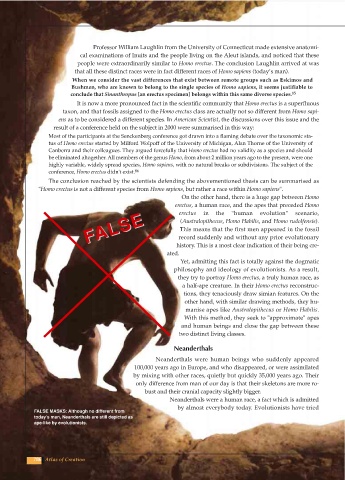
                FALSE MASKS: Although no different from
                today’s man, Neanderthals are still depicted as
                ape-like by evolutionists.


                786 Atlas of Creation

