


Page 794 - Atlas of Creation Volume 1
P. 794
A Human Mandible Aged 2.3 Million Y


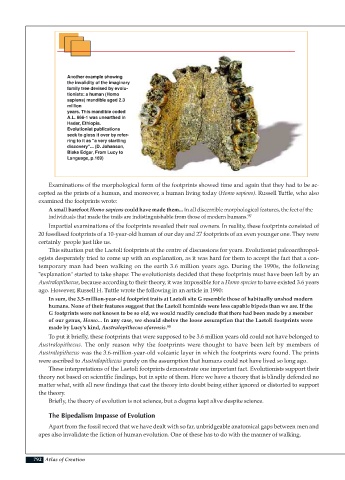
                               Another example showing                                                                      ears
                               the invalidity of the imaginary
                               family tree devised by evolu-
                               tionists: a human (Homo
                               sapiens) mandible aged 2.3
                               million
                               years. This mandible coded
                               A.L. 666-1 was unearthed in
                               Hadar, Ethiopia.
                               Evolutionist publications
                               seek to gloss it over by refer-
                               ring to it as "a very startling
                               discovery"... (D. Johanson,
                               Blake Edgar, From Lucy to
                               Language, p.169)


                       Examinations of the morphological form of the footprints showed time and again that they had to be ac-
                  cepted as the prints of a human, and moreover, a human living today (Homo sapiens). Russell Tuttle, who also

                  examined the footprints wrote:
                       A small barefoot Homo sapiens could have made them... In all discernible morphological features, the feet of the
                       individuals that made the trails are indistinguishable from those of modern humans.      97

                       Impartial examinations of the footprints revealed their real owners. In reality, these footprints consisted of
                  20 fossilised footprints of a 10-year-old human of our day and 27 footprints of an even younger one. They were
                  certainly  people just like us.
                       This situation put the Laetoli footprints at the centre of discussions for years. Evolutionist paleoanthropol-

                  ogists desperately tried to come up with an explanation, as it was hard for them to accept the fact that a con-
                  temporary man had been walking on the earth 3.6 million years ago. During the 1990s, the following
                  "explanation" started to take shape: The evolutionists decided that these footprints must have been left by an
                  Australopithecus, because according to their theory, it was impossible for a Homo species to have existed 3.6 years

                  ago. However, Russell H. Tuttle wrote the following in an article in 1990:
                       In sum, the 3.5-million-year-old footprint traits at Laetoli site G resemble those of habitually unshod modern
                       humans. None of their features suggest that the Laetoli hominids were less capable bipeds than we are. If the
                       G footprints were not known to be so old, we would readily conclude that there had been made by a member
                       of our genus, Homo... In any case, we should shelve the loose assumption that the Laetoli footprints were
                       made by Lucy's kind, Australopithecus afarensis.     98

                       To put it briefly, these footprints that were supposed to be 3.6 million years old could not have belonged to
                  Australopithecus. The only reason why the footprints were thought to have been left by members of
                  Australopithecus was the 3.6-million-year-old volcanic layer in which the footprints were found. The prints
                  were ascribed to Australopithecus purely on the assumption that humans could not have lived so long ago.
                       These interpretations of the Laetoli footprints demonstrate one important fact. Evolutionists support their

                  theory not based on scientific findings, but in spite of them. Here we have a theory that is blindly defended no
                  matter what, with all new findings that cast the theory into doubt being either ignored or distorted to support
                  the theory.

                       Briefly, the theory of evolution is not science, but a dogma kept alive despite science.

                       The Bipedalism Impasse of Evolution


                       Apart from the fossil record that we have dealt with so far, unbridgeable anatomical gaps between men and
                  apes also invalidate the fiction of human evolution. One of these has to do with the manner of walking.


                792 Atlas of Creation

