


Page 816 - Atlas of Creation Volume 1
P. 816
The Miraculous Molecule: DNA


                                     Our examinations so far have shown that the theory of evolution is in a serious quandary at
                                        the molecular level. Evolutionists have shed no light on the formation of amino acids at all.
                                              The formation of proteins, on the other hand, is another mystery all its own.
                                                      Yet the problems are not even limited just to amino acids and proteins: These

                                                         are only the beginning. Beyond them, the extremely complex structure of the
                                                                            cell leads evolutionists to yet another impasse. The reason
                                                                                  for this is that the cell is not just a heap of amino-acid-

                                                                                      structured proteins, but rather the most complex
                                                                                         system man has ever encountered.
                                                                                                While the theory of evolution was having
                                                                                             such trouble providing a coherent explana-
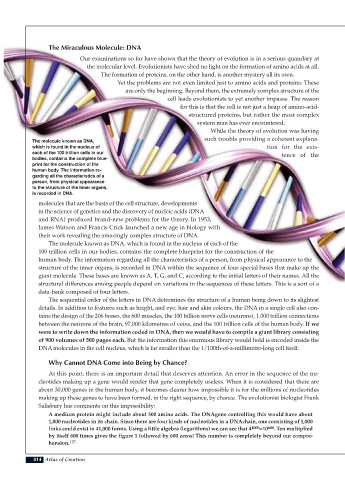
                The molecule known as DNA,
                which is found in the nucleus of                                                                         tion for the exis-
                each of the 100 trillion cells in our                                                                          tence of the
                bodies, contains the complete blue-
                print for the construction of the
                human body. The information re-
                garding all the characteristics of a
                person, from physical appearance
                to the structure of the inner organs,
                is recorded in DNA.
                  molecules that are the basis of the cell structure, developments
                  in the science of genetics and the discovery of nucleic acids (DNA

                  and RNA) produced brand-new problems for the theory. In 1953,
                  James Watson and Francis Crick launched a new age in biology with
                  their work revealing the amazingly complex structure of DNA.

                       The molecule known as DNA, which is found in the nucleus of each of the
                  100 trillion cells in our bodies, contains the complete blueprint for the construction of the
                  human body. The information regarding all the characteristics of a person, from physical appearance to the
                  structure of the inner organs, is recorded in DNA within the sequence of four special bases that make up the
                  giant molecule. These bases are known as A, T, G, and C, according to the initial letters of their names. All the

                  structural differences among people depend on variations in the sequences of these letters. This is a sort of a
                  data-bank composed of four letters.
                       The sequential order of the letters in DNA determines the structure of a human being down to its slightest

                  details. In addition to features such as height, and eye, hair and skin colours, the DNA in a single cell also con-
                  tains the design of the 206 bones, the 600 muscles, the 100 billion nerve cells (neurons), 1.000 trillion connections
                  between the neurons of the brain, 97,000 kilometres of veins, and the 100 trillion cells of the human body. If we
                  were to write down the information coded in DNA, then we would have to compile a giant library consisting
                  of 900 volumes of 500 pages each. But the information this enormous library would hold is encoded inside the

                  DNA molecules in the cell nucleus, which is far smaller than the 1/100th-of-a-millimetre-long cell itself.

                       Why Cannot DNA Come into Being by Chance?


                       At this point, there is an important detail that deserves attention. An error in the sequence of the nu-
                  cleotides making up a gene would render that gene completely useless. When it is considered that there are
                  about 30,000 genes in the human body, it becomes clearer how impossible it is for the millions of nucleotides

                  making up these genes to have been formed, in the right sequence, by chance. The evolutionist biologist Frank
                  Salisbury has comments on this impossibility:
                       A medium protein might include about 300 amino acids. The DNAgene controlling this would have about
                       1,000 nucleotides in its chain. Since there are four kinds of nucleotides in a DNAchain, one consisting of 1,000
                       links could exist in 41,000 forms. Using a little algebra (logarithms) we can see that 4   1000 =10 600 . Ten multiplied
                       by itself 600 times gives the figure 1 followed by 600 zeros! This number is completely beyond our compre-
                       hension. 125


                814 Atlas of Creation

