


Page 820 - Atlas of Creation Volume 1
P. 820
Confessions fr om Evolutionists


                                  robabilistic calculations make it clear that
                                  complex molecules such as proteins and nu-
                          Pcleic acids (RNA and DNA) could not ever
                          have been formed by chance independently of each

                          other. Yet evolutionists have to face the even greater
                          problem that all these complex molecules have to
                          coexist simultaneously in order for life to exist at all.

                          Evolutionary theory is utterly confounded by this re-
                          quirement. This is a point on which some leading
                          evolutionists have been forced to confession. For
                          instance, Stanley Miller's and Francis Crick's close
                          associate from the University of San Diego

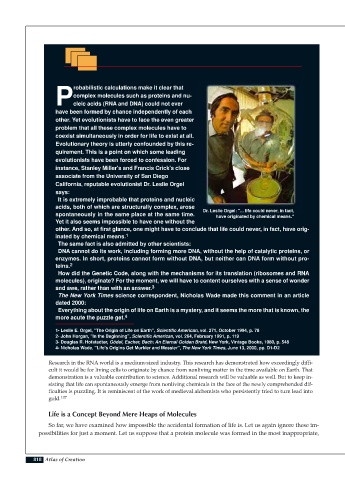
                          California, reputable evolutionist Dr. Leslie Orgel
                          says:
                           It is extremely improbable that proteins and nucleic
                          acids, both of which are structurally complex, arose
                                                                                            Dr. Leslie Orgel: "... life could never, in fact,
                          spontaneously in the same place at the same time.                       have originated by chemical means."
                          Yet it also seems impossible to have one without the
                          other. And so, at first glance, one might have to conclude that life could never, in fact, have orig-
                          inated by chemical means.       1
                           The same fact is also admitted by other scientists:

                           DNA cannot do its work, including forming more DNA, without the help of catalytic proteins, or
                          enzymes. In short, proteins cannot form without DNA, but neither can DNA form without pro-
                          teins. 2
                           How did the Genetic Code, along with the mechanisms for its translation (ribosomes and RNA
                          molecules), originate? For the moment, we will have to content ourselves with a sense of wonder
                          and awe, rather than with an answer.       3
                           The New York Times science correspondent, Nicholas Wade made this comment in an article
                          dated 2000:
                           Everything about the origin of life on Earth is a mystery, and it seems the more that is known, the
                          more acute the puzzle get.     4


                          1- Leslie E. Orgel, "The Origin of Life on Earth", Scientific American, vol. 271, October 1994, p. 78
                          2- John Horgan, "In the Beginning", Scientific American, vol. 264, February 1991, p. 119
                          3- Douglas R. Hofstadter, Gödel, Escher, Bach: An Eternal Golden Braid, New York, Vintage Books, 1980, p. 548
                          4- Nicholas Wade, "Life's Origins Get Murkier and Messier", The New York Times, June 13, 2000, pp. D1-D2


                       Research in the RNA world is a medium-sized industry. This research has demonstrated how exceedingly diffi-
                       cult it would be for living cells to originate by chance from nonliving matter in the time available on Earth. That
                       demonstration is a valuable contribution to science. Additional research will be valuable as well. But to keep in-
                       sisting that life can spontaneously emerge from nonliving chemicals in the face of the newly comprehended dif-
                       ficulties is puzzling. It is reminiscent of the work of medieval alchemists who persistently tried to turn lead into
                       gold. 137


                       Life is a Concept Beyond Mere Heaps of Molecules

                       So far, we have examined how impossible the accidental formation of life is. Let us again ignore these im-
                  possibilities for just a moment. Let us suppose that a protein molecule was formed in the most inappropriate,


                818 Atlas of Creation

