


Page 898 - Atlas of Creation Volume 1
P. 898
The Scientific Explanation of Timelessness


                       We can clarify this subject by quoting various scientists' and scholars' explanations. Regarding the idea of
                  time flowing backwards, François Jacob, a famous intellectual and Nobel laureate professor of genetics, states
                  the following in his book Le Jeu des Possibles (The Play of Possibilities):

                       Films played backwards let us imagine a world in which time flows backwards. A world in which cream separates
                       itself from the coffee and jumps out of the cup to reach the creamer; in which the walls emit light rays that are col-
                       lected in a light source instead of radiating out from it; a world in which a stone leaps up to a man's hand from the
                       water where it was thrown by the astonishing cooperation of innumerable drops of water surging together. Yet, in
                       such a time-reversed world with such opposite features, our brain processes, and the way our memory compiles in-
                       formation, would similarly function backwards. The same is true for the past and future, though the world will ap-
                       pear to us exactly as it does currently. 205
                       But since our brain is accustomed to a certain sequence of events, the world does not operate as related

                  above. We assume that time always flows forward. However, this is a decision reached in the brain and is,
                  therefore, completely relative. In reality, we never can know how time flows—or even whether it flows or not!
                  This is because time is not an absolute fact, but only a form of perception.
                       That time is a perception is also verified by Albert Einstein in his Theory of General Relativity. In his book
                  The Universe and Dr. Einstein, Lincoln Barnett writes:

                       Along with absolute space, Einstein discarded the concept of absolute time—of a steady, unvarying inexorable uni-
                       versal time flow, streaming from the infinite past to the infinite future. Much of the obscurity that has surrounded
                       the Theory of Relativity stems from man's reluctance to recognize that sense of time, like sense of color, is a form of
                       perception. Just as space is simply a possible order of material objects, so time is simply a possible order of events.
                       The subjectivity of time is best explained in Einstein's own words. "The experiences of an individual," he says, "ap-
                       pear to us arranged in a series of events; in this series the single events which we remember appear to be ordered ac-
                       cording to the criterion of 'earlier' and 'later'. There exists, therefore, for the individual, an I-time, or subjective time.
                       This in itself is not measurable. I can, indeed, associate numbers with the events, in such a way that a greater num-
                       ber is associated with the later event than with an earlier one. 206

                       As Barnett wrote, Einstein showed that, "space and time are forms of intuition, which can no more be di-
                  vorced from consciousness than can our concepts of color, shape, or size." According to the Theory of General
                  Relativity: "time has no independent existence apart from the order of events by which we measure it."               207
                       Since time consists of perception, it depends entirely on the perceiver—and is therefore relative.


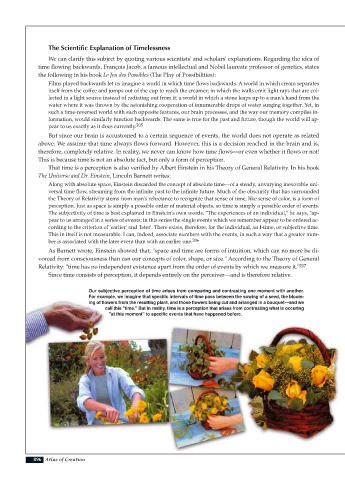
                                         Our subjective perception of time arises from comparing and contrasting one moment with another.
                                         For example, we imagine that specific intervals of time pass between the sowing of a seed, the bloom-
                                         ing of flowers from the resulting plant, and those flowers being cut and arranged in a bouquet—and we
                                                call this "time." But in reality, time is a perception that arises from contrasting what is occuring
                                                  "at this moment" to specific events that have happened before.


                896 Atlas of Creation

