


Page 899 - Atlas of Creation Volume 1
P. 899
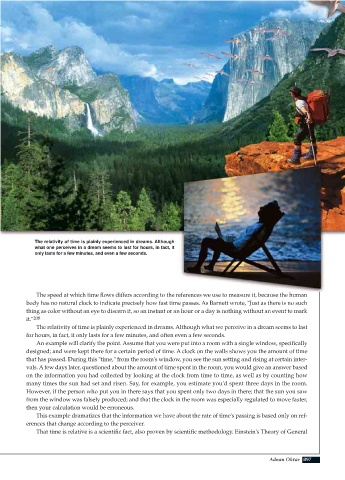
The relativity of time is plainly experienced in dreams. Although
                 what one perceives in a dream seems to last for hours, in fact, it
                 only lasts for a few minutes, and even a few seconds.


                 The speed at which time flows differs according to the references we use to measure it, because the human
             body has no natural clock to indicate precisely how fast time passes. As Barnett wrote, "Just as there is no such
             thing as color without an eye to discern it, so an instant or an hour or a day is nothing without an event to mark

             it." 208
                 The relativity of time is plainly experienced in dreams. Although what we perceive in a dream seems to last
             for hours, in fact, it only lasts for a few minutes, and often even a few seconds.
                 An example will clarify the point. Assume that you were put into a room with a single window, specifically

             designed; and were kept there for a certain period of time. A clock on the walls shows you the amount of time
             that has passed. During this "time," from the room's window, you see the sun setting and rising at certain inter-
             vals. A few days later, questioned about the amount of time spent in the room, you would give an answer based
             on the information you had collected by looking at the clock from time to time, as well as by counting how

             many times the sun had set and risen. Say, for example, you estimate you'd spent three days in the room.
             However, if the person who put you in there says that you spent only two days in there; that the sun you saw
             from the window was falsely produced; and that the clock in the room was especially regulated to move faster,
             then your calculation would be erroneous.

                 This example dramatizes that the information we have about the rate of time's passing is based only on ref-
             erences that change according to the perceiver.
                 That time is relative is a scientific fact, also proven by scientific methodology. Einstein's Theory of General


                                                                                                                          Adnan Oktar    897

