


Page 22 - Five Forces of Americanisation Richard Hooke 04072025 final post SDR1
P. 22
The UK Defence Industry in the 21  Century
                                                                        st
                                            The Five Forces of Americanisation

               Our 2005 paper discussed how defence spending can be optimised by achieving the right balance
               between domestic programmes and exports and by developing and sustaining the right international
               alliances in the process. It described “why the trade in defence equipment is such a vital component
                                       3
               of national security policy” .
               Now, in a world where conflict is a major theme and the US has expressed a desire to disengage from
               European security, the full extent of the value of a robust national DIB has become more widely
               understood, particularly its practical role in building and strengthening international relationships.
               Military sales do not take place in a vacuum. They envisage a conflict, usually with a possible aggressor,
               with a specified term in mind. Equipment needs updating, refreshing, replacing or supplementing over
               a  life  cycle  spanning  several  years.  The  buyer–seller  relationship  is  intimate  and  enduring  (see
               Appendix 4).

                     A  resilient  industrial  base  underpins  Defence’s  credibility  as  a  fighting  force….  Our  witnesses
                     strongly  emphasised  the  role  that  the  Government  should  play  in  reversing  this  process.”
                     (House of Lords International Relations Committee 26 Sept 2024 “Ukraine: a wake-up call”)
               In  the  UK’s  case,  Boris  Johnson  was  therefore  able  unilaterally  to  pledge  practical  support  to
               Volodymyr Zelensky  when  the  US  and others  in  the  west  remained  cautious  in  the early  days of
               Russia’s invasion of Ukraine.

                     Speaking at London’s Frontline Club in the spring of 2024 , The Wall Street Journal’s Yaroslav
                                                                   4
                     Trofimov recounted that “in the months before the Russian invasion, few in Washington and even
                     fewer in Paris or Berlin, held faith in Ukraine’s ability to resist. The United States supplied ninety
                     Javelin shoulder-fired antitank missiles … not nearly enough to match the thousands of Russian
                     tanks arrayed on the border. With American permission, the Baltic states sent a few Stinger man-
                     portable air defence missiles, a weapon that America had provided to Afghanistan’s mujahedeen
                     in the 1980s. Britain, in perhaps the most consequential commitment, shipped about 2,000 short-
                     range antitank missiles (NLAW)”
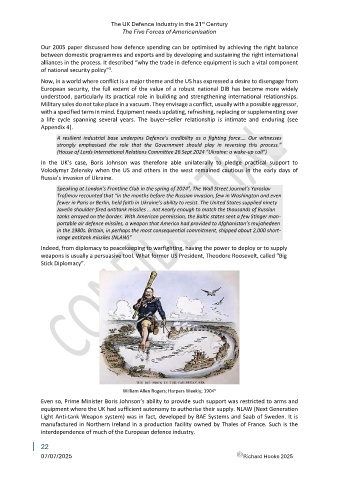
               Indeed, from diplomacy to peacekeeping to warfighting, having the power to deploy or to supply
               weapons is usually a persuasive tool. What former US President, Theodore Roosevelt, called “Big
               Stick Diplomacy”.


                                            William Allen Rogers; Harpers Weekly; 1904 5
               Even so, Prime Minister Boris Johnson’s ability to provide such support was restricted to arms and
               equipment where the UK had sufficient autonomy to authorise their supply. NLAW (Next Generation
               Light Anti-tank Weapon system) was in fact, developed by BAE Systems and Saab of Sweden. It is
               manufactured in Northern Ireland in a production facility owned by Thales of France. Such is the
               interdependence of much of the European defence industry.

               22
               07/07/2025                                                                                                                                   Richard Hooke 2025

