


Page 37 - BiTS_12_DECEMBER_2025
P. 37
were  often  Little  Walter,  Willie  Dixon,  and  Muddy  Waters,  with  others  such  as  Big
      Crawford, Elgin Evans/S.P. Leary/Fred Below (drums), J. T. Brown, and Henry Gray/Otis

      Spann (piano). Songs recorded in this period include 'The World’s In A Tangle' (covered
      by Fleetwood Mac on “Blues Jam At Chess”), 'That’s All Right', 'Blues All Day' (covered by
                                                                               Eric  Clapton  on  various
                                                                               albums) and 'Chicago Bound'.
                                                                               The latter years of the decade
                                                                               saw  him  also  recording  with
                                                                               Big  Walter  Horton  (harm-

                                                                               onica), Robert Jnr. Lockwood
                                                                               /Mighty  Joe  Young/  Luther
                                                                               Tucker/ Fred Robinson   (guit-
                                                                               ar) amongst others, all repres-
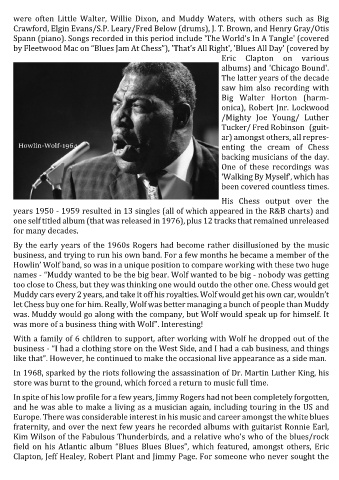
        Howlin-Wolf-1964                                                       enting  the  cream  of  Chess

                                                                               backing musicians of the day.
                                                                               One  of  these  recordings  was
                                                                               ‘Walking By Myself’, which has
                                                                               been covered countless times.

                                                                               His  Chess  output  over  the
      years 1950 - 1959 resulted in 13 singles (all of which appeared in the R&B charts) and

      one self titled album (that was released in 1976), plus 12 tracks that remained unreleased
      for many decades.

      By the early years of the 1960s Rogers had become rather disillusioned by the music
      business, and trying to run his own band. For a few months he became a member of the
      Howlin’ Wolf band, so was in a unique position to compare working with these two huge
      names - “Muddy wanted to be the big bear. Wolf wanted to be big - nobody was getting

      too close to Chess, but they was thinking one would outdo the other one. Chess would get
      Muddy cars every 2 years, and take it off his royalties. Wolf would get his own car, wouldn’t
      let Chess buy one for him. Really, Wolf was better managing a bunch of people than Muddy
      was. Muddy would go along with the company, but Wolf would speak up for himself. It
      was more of a business thing with Wolf”. Interesting!

      With a family of 6 children to support, after working with Wolf he dropped out of the

      business - “I had a clothing store on the West Side, and I had a cab business, and things
      like that”. However, he continued to make the occasional live appearance as a side man.

      In 1968, sparked by the riots following the assassination of Dr. Martin Luther King, his
      store was burnt to the ground, which forced a return to music full time.

      In spite of his low profile for a few years, Jimmy Rogers had not been completely forgotten,
      and he was able to make a living as a musician again, including touring in the US and
      Europe. There was considerable interest in his music and career amongst the white blues

      fraternity, and over the next few years he recorded albums with guitarist Ronnie Earl,
      Kim Wilson of the Fabulous Thunderbirds, and a relative who’s who of the blues/rock
      field on his Atlantic album “Blues Blues Blues”, which featured, amongst others, Eric
      Clapton, Jeff Healey, Robert Plant and Jimmy Page. For someone who never sought the

