


Page 38 - BiTS_12_DECEMBER_2025
P. 38
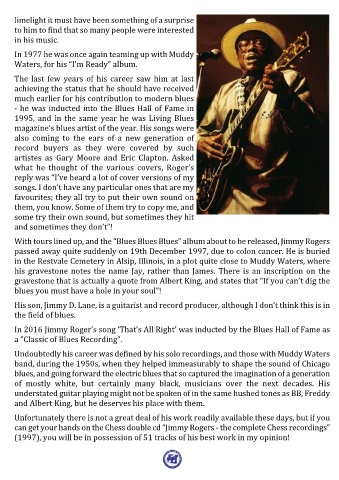
limelight it must have been something of a surprise
      to him to find that so many people were interested
      in his music.

      In 1977 he was once again teaming up with Muddy
      Waters, for his “I’m Ready” album.

      The  last  few  years  of  his  career  saw  him  at  last

      achieving the status that he should have received
      much earlier for his contribution to modern blues
      - he was inducted into the Blues Hall of Fame in
      1995, and in the same year he was Living Blues
      magazine’s blues artist of the year. His songs were
      also  coming  to  the  ears  of  a  new  generation  of

      record  buyers  as  they  were  covered  by  such
      artistes  as  Gary  Moore  and  Eric  Clapton.  Asked
      what  he  thought  of  the  various  covers,  Roger’s
      reply was “I’ve heard a lot of cover versions of my
      songs. I don’t have any particular ones that are my
      favourites; they all try to put their own sound on
      them, you know. Some of them try to copy me, and

      some try their own sound, but sometimes they hit
      and sometimes they don’t”!

      With tours lined up, and the “Blues Blues Blues” album about to be released, Jimmy Rogers
      passed away quite suddenly on 19th December 1997, due to colon cancer. He is buried
      in the Restvale Cemetery in Alsip, Illinois, in a plot quite close to Muddy Waters, where
      his gravestone notes the name Jay, rather than James. There is an inscription on the

      gravestone that is actually a quote from Albert King, and states that “If you can’t dig the
      blues you must have a hole in your soul”!

      His son, Jimmy D. Lane, is a guitarist and record producer, although I don’t think this is in
      the field of blues.

      In 2016 Jimmy Roger’s song ‘That’s All Right’ was inducted by the Blues Hall of Fame as

      a “Classic of Blues Recording”.

      Undoubtedly his career was defined by his solo recordings, and those with Muddy Waters
      band, during the 1950s, when they helped immeasurably to shape the sound of Chicago
      blues, and going forward the electric blues that so captured the imagination of a generation
      of  mostly  white,  but  certainly  many  black,  musicians  over  the  next  decades.  His
      understated guitar playing might not be spoken of in the same hushed tones as BB, Freddy

      and Albert King, but he deserves his place with them.

      Unfortunately there is not a great deal of his work readily available these days, but if you
      can get your hands on the Chess double cd “Jimmy Rogers - the complete Chess recordings”
      (1997), you will be in possession of 51 tracks of his best work in my opinion!

