


Page 12 - 14 November 2025
P. 12
PAGE 12 · THE REPORTER 14 NOVEMBER 2025

                                     lightly streaked.
                                     They eat seed and fruit and
                                     sometimes  insects.  They
                                     prefer  arid  and  semi-arid
                                     scrub  although  it  is,  like
                                     m o s t   s e e d - e a t e r s ,
                                     dependent  on  standing
                                     water.  They  are  listed  as  a
             AT LAST!                common  endemic  and  are
             On  Saturday,  we  went   considered nomadic as they
             birding. We chose one of our   move around to where there
             favourite  routes,  Suurvlakte   is suitable water.
             along  the  tar  and  back  to   Another  nice  sighting  was
             town via the dirt road, a nice   t h e   B a n d e d   M a r t i n
             round route - not too long in   (Gebande Oewerswael). It is
             case  the  weather  did  not   a fairly large martin and has a
             hold.                   distinct  white  eyebrow.  We
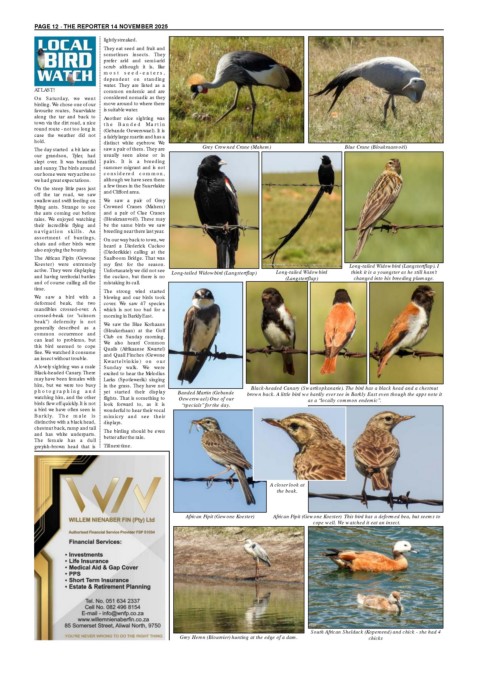
             The day started  a bit late as   saw a pair of them. They are   Grey Crowned Crane (Mahem)                   Blue Crane (Bloukraanvoël)
             our  grandson,  Tyler,  had   usually  seen  alone  or  in
             slept  over.  It  was  beautiful   pairs.  It  is  a  breeding
             and sunny. The birds around   summer migrant and is not
             our home were very active so   considered  common,
             we had great expectations.  although we have seen them
                                     a few times in the Suurvlakte
             On the steep little pass just
             off  the  tar  road,  we  saw   and Clifford area.
             swallow and swift feeding on   We  saw  a  pair  of  Grey
             flying  ants.  Strange  to  see   Crowned  Cranes  (Mahem)
             the ants coming out before   and  a  pair  of  Clue  Cranes
             rains. We enjoyed watching   (Bloukraanvoël). These may
             their  incredible  flying  and   be  the  same  birds  we  saw
             navigation  skills.  An   breeding near there last year.
             assortment  of  buntings,   On our way back to town, we
             chats  and  other  birds  were   heard  a  Diederick  Cuckoo
             also enjoying the bounty.
                                     (Diederikkie)  calling  at  the
             The  African  Pipits  (Gewone   Saalboom Bridge. That was
             Koester)  were  extremely   my  first  for  the  season.                                                       Long-tailed Widowbird (Langstertflap). I
             active. They were displaying   Unfortunately we did not see   Long-tailed Widowbird (Langstertflap)   Long-tailed Widowbird   think it is a youngster as he still hasn't
             and having territorial battles   the cuckoo, but there is no                            (Langstertflap)         changed into his breeding plumage.
             and of course calling all the   mistaking its call.
             time.
                                     The  strong  wind  started
             We  saw  a  bird  with  a   blowing and our birds took
             deformed  beak,  the  two   cover.  We  saw  47  species
             mandibles  crossed-over.  A   which  is  not  too  bad  for  a
             crossed-beak  (or  "scissors   morning in Barkly East.
             beak")  deformity  is  not   We  saw  the  Blue  Korhaans
             generally  described  as  a   (Bloukorhaan)  at  the  Golf
             common  occurrence  and   Club  on  Sunday  morning.
             can  lead  to  problems,  but   We  also  heard  Common
             this  bird  seemed  to  cope   Quails  (Afrikaanse  Kwartel)
             fine. We watched it consume   and Quail Finches (Gewone
             an insect without trouble.
                                     Kwartelvinkie)  on  our
             A lovely sighting was a male   Sunday  walk.  We  were
             Black-headed Canary. There   excited to hear the Melodius
             may have been females with   Larks  (Spotlewerik)  singing
             him,  but  we  were  too  busy   in the grass. They have not
                                                                                         Black-headed Canary (Swartkopkanarie). The bird has a black head and a chestnut
             p h o t o g r a p h i n g   a n d    yet  started  their  display   Banded Martin (Gebande   brown back. A little bird we hardly ever see in Barkly East even though the apps note it
             watching him, and the other   flights. That is something to   Oewerswael) One of our            as a “locally common endemic”.
             birds flew off quickly. It is not   look  forward  to,  as  it  is   “specials” for the day.
             a bird we have often seen in   wonderful to hear their vocal
             B a r k l y.   T h e   m a l e   i s    mimicry  and  see  their
             distinctive with a black head,   displays.
             chestnut back, rump and tail   The birding should be even
             and  has  white  underparts.
             The  female  has  a  dull   better after the rain.
             greyish-brown  head  that  is   Till next time.


                                                                                                A closer look at
                                                                                                  the beak.


                                                                  African Pipit (Gewone Koester)   African Pipit (Gewone Koester)  This bird has a deformed bea, but seems to
                                                                                                               cope well. We watched it eat an insect.


                                                                                                              South African Shelduck (Kopereend) and chick - she had 4
                                                                Grey Heron (Bloureier) hunting at the edge of a dam.              chicks

