


Page 1 - 21 November 2025
P. 1
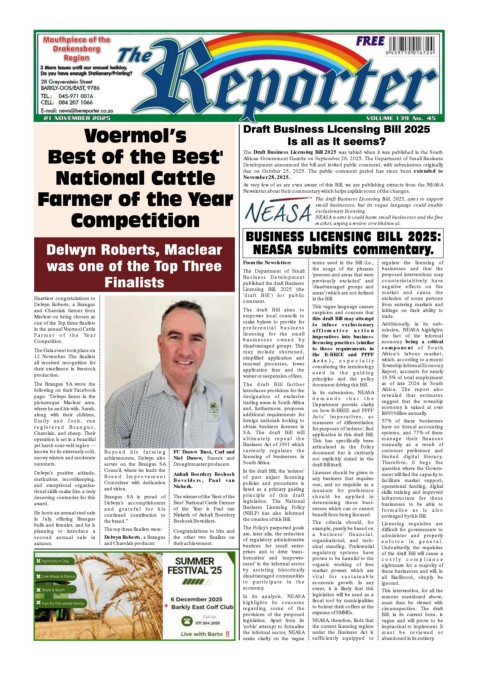
The Draft Business Licensing Bill 2025 was tabled when it was published in the South
African Government Gazette on September 26, 2025. The Department of Small Business
Development announced the bill and invited public comment, with submissions originally
due on October 25, 2025. The public comment period has since been extended to
November 28, 2025.
As very few of us are even aware of this Bill, we are publishing extracts from the NEASA
Newsletter about their commentary which helps explain some of the changes.
The draft Business Licensing Bill, 2025, aims to support
small businesses, but its vague language could enable
exclusionary licensing.
NEASA warns it could harm small businesses and the free
market, urging a review or withdrawal.
From the Newsletter: terms used in the Bill (i.e., regulate the licensing of
the usage of the phrases businesses and that the
The Department of Small
Business Development 'persons and areas that were proposed interventions may
published the draft Business previously excluded' and counterintuitively have
Licensing Bill, 2025 (the 'disadvantaged groups and negative effects on the
market and cause the
'draft Bill') for public areas') which are not defined
Heartiest congratulations to comment. in the Bill. exclusion of some persons
Delwyn Roberts, a Brangus This vague language causes from entering markets and
and Charolais farmer from The draft Bill aims to suspicion and concern that infringe on their ability to
Maclear on being chosen as empower local councils to this draft Bill may attempt trade.
one of the Top three finalists make bylaws to provide for to infuse exclusionary Additionally, in its sub-
in the annual Voermol Cattle preferential business a f f i r m a t i v e a c t i o n mission, NEASA highlights
Fa r m e r o f t h e Ye a r licensing for the small imperatives into business the fact of the informal
Competition. businesses owned by licensing practices (similar economy being a critical
disadvantaged groups. This component of South
The Gala event took place on may include shortened, to those requirements in
12 November. The finalists simplified application and the B-BBEE and PPPF Africa's labour market,
which, according to a recent
all received recognition for renewal processes, lower A c t s ) , e s p e c i a l l y Township Informal Economy
their excellence in livestock application fees and the considering the terminology Report, accounts for nearly
production. waiver or suspension of fees. used in the guiding
principles and the policy 19.5% of total employment
The Brangus SA wrote the The draft Bill further document driving this Bill. as of late 2024 in South
following on their Facebook introduces provisions for the In its submission, NEASA Africa. The report also
page: “Delwyn farms in the designation of exclusive d e m a n d s t h a t t h e revealed that estimates
picturesque Maclear area, trading areas in South Africa Department provide clarity suggest that the township
where he and his wife, Sarah, and, furthermore, proposes on how B-BBEE and PPPF economy is valued at over
along with their children, additional requirements for Acts' imperatives, as R900 billion annually.
Emily and Josh, run foreign nationals looking to measures of differentiation 57% of these businesses
r e g i s t e r e d B r a n g u s , obtain business licenses in for purposes of 'redress', find have no formal accounting
Charolais, and sheep. Their SA. The draft Bill will application in this draft Bill. systems, and 77% of them
operation is set in a beautiful ultimately repeal the This has specifically been manage their finances
yet harsh sour-veld region — Business Act of 1991 which articulated in the Policy manually as a result of
known for its extremely cold, B e y o n d h i s f a r m i n g FC Durow Trust, Carl and currently regulates the document but is curiously customer preference and
snowy winters and moderate achievements, Delwyn also Niel Durow, Sussex and licensing of businesses in not explicitly stated in the limited digital literacy.
summers. serves on the Brangus SA Droughtmaster producers. South Africa. draft Bill itself. Therefore, it begs the
Council, where he leads the In the draft Bill, the 'redress' question where the Govern-
Delwyn's positive attitude, Anhali Boerdery Boshoek Licenses should be given to ment will find the capacity to
meticulous recordkeeping, B r e e d I m p r o v e m e n t Bovelders, Paul van of past unjust licensing any business that requires facilitate market support,
and exceptional organisa- Committee with dedication Niekerk. policies and procedures is one, and no requisite as a operational funding, digital
tional skills make him a truly and vision. listed as a primary guiding measure for preference skills training and improved
deserving contender for this Brangus SA is proud of The winner of the 'Best of the principle of this draft should be applied in infrastructure for these
award. Delwyn's accomplishment Best' National Cattle Farmer legislation. The National determining those busi- businesses to be able to
and grateful for his of the Year is Paul van Business Licensing Policy nesses which can or cannot formalise as is also
He hosts an annual stud sale continued contribution to Niekerk of Anhali Boerdery (NBLP) has also informed benefit from being licensed.
in July, offering Brangus the breed.” Boshoek Bovelders. the creation of this Bill. envisaged by this Bill.
bulls and females, and he is The Policy's purported goals The criteria should, for Licensing requisites are
planning to introduce a The top three finalists were: Congratulations to him and are, inter alia, the reduction example, purely be based on difficult for governments to
a business' financial,
second annual sale in Delwyn Roberts, a Brangus the other two finalists on of regulatory administrative administer and properly
autumn. and Charolais producer. their achievement. organisational, and tech- e n f o r c e i n g e n e r a l .
burdens for small enter- nical standing. Preferential Undoubtedly, the requisites
prises and to drive 'trans- regulatory systems have of the draft Bill will cause a
formation' and 'empower- proven to be harmful to the c o s t l y c o m p l i a n c e
ment' in the informal sector organic working of free nightmare for a majority of
by assisting historically market powers which are these businesses and will, in
disadvantaged communities v i t a l f o r s u s t a i n a b l e all likelihood, simply be
to participate in the economic growth. In any ignored.
economy. event, it is likely that this This intervention, for all the
In its analysis, NEASA legislation will be used as a reasons mentioned above,
highlights its concerns fiscal tool by municipalities must thus be viewed with
regarding some of the to bolster their coffers at the circumspection. The draft
provisions of the proposed expense of SMMEs. Bill, in its current form, is
legislation. Apart from its NEASA, therefore, finds that vague and will prove to be
'noble' attempt to formalise the current licensing regime impractical to implement. It
the informal sector, NEASA under the Business Act is must be reviewed or
seeks clarity on the vague sufficiently equipped to abandoned in its entirety.

