


Page 10 - 21 November 2025
P. 10
PAGE 10 · THE REPORTER 21 NOVEMBER 2025

                                     years.  Spotted  Flycatchers
                                     often return to the same site
                                     each year, and are amongst
                                     the  first  migrants  to  arrive
                                     each summer.”
                                     We  have  only  seen  the
                                     following  flycatchers  in  our
                                     garden: Fairy Flycatcher and
             So  many  of  the  summer   Fiscal  Flycatcher,  and  now
             birds have arrived. The skies   we can add the little Spotted
             are  abuzz  with  swifts  and   Flycatcher to the very short
             swallows.               list.
             After  the  rain,  the  swallows   We  have  also  seen  Dusky
             have  been  hard  at  work   and  Paradise  Flycatchers
             gathering  mud  to  build  or   elsewhere in town.
             repair  their  nests.  I  often                 Kevin Meise
             bump  into  the  Greater   By Saturday early afternoon
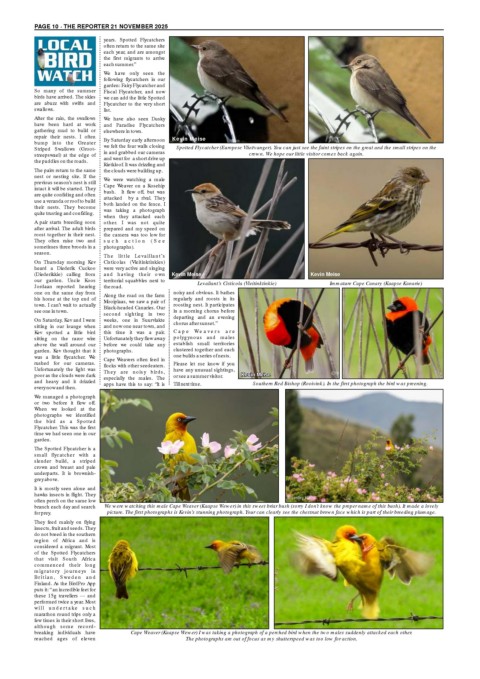
             Striped  Swallows  (Groot-  we felt the four walls closing   Spotted Flycatcher (Europese Vlieëvanger). You can just see the faint stripes on the great and the small stripes on the
                                     in and grabbed our cameras
             streepswael) at the edge of                                                crown. We hope our little visitor comes back again.
             the puddles on the roads.   and went for  a short drive up
                                     Rietkloof. It was drizzling and
             The pairs return to the same   the clouds were building up.
             nest  or  nesting  site.  If  the   We  were  watching  a  male
             previous season’s nest is still   Cape Weaver on a Rosehip
             intact it will be started. They
             are quite confiding and often   bush.    It  flew  off,  but  was
             use a veranda or roof to build   attacked    by  a  rival.  They
                                     both landed on the fence. I
             their  nests.  They  become   was  taking  a  photograph
             quite trusting and confiding.
                                     when  they  attacked  each
             A pair starts breeding soon   other.  I  was  not  quite
             after arrival. The adult birds   prepared and my speed on
             roost together in their nest.   the camera was too low for
             They  often  raise  two  and   s u c h   a c t i o n   ( S e e
             sometimes three broods in a   photographs).
             season.
                                     The  little  Levaillant’s
             On  Thursday  morning  Kev   Cisticolas  (Vleitinktinkies)
             heard  a  Diederik  Cuckoo   were very active and singing
             (Diederikkie)  calling  from   and  having  their  own  Kevin Meise                              Kevin Meise
             our  garden.  Uncle  Koos   territorial squabbles next to
             Jordaan  reported  hearing   the road.                   Levaliant’s Cisticola (Vleitinktinkie)         Immature Cape Canary (Kaapse Kanarie)
             one on the same day from   Along the road on the farm   noisy and obvious. It bathes
             his home at the top end of   Mooiplaas, we saw a pair of   regularly  and  roosts  in  its
             town. I can’t wait to actually   Black-headed Canaries. Our   roosting nest. It participates
             see one in town.                                 in a morning chorus before
                                     second  sighting  in  two
             On Saturday, Kev and I were   weeks,  one  in  Suurvlakte   departing  and  an  evening
             sitting  in  our  lounge  when   and now one near town, and   chorus after sunset.”
             Kev  spotted  a  little  bird   this  time  it  was  a  pair.   C a p e   W e a v e r s   a r e
             sitting  on  the  razor  wire   Unfortunately they flew away   polygynous  and  males
             above  the  wall  around  our   before  we  could  take  any   establish  small  territories
             garden. Kev thought that it   photographs.       clustered together and each
             was  a  little  flycatcher.  We   Cape Weavers often feed in   one builds a series of nests.
             rushed  for  our  cameras.   flocks with other seedeaters.   Please  let  me  know  if  you
             Unfortunately  the  light  was   They  are  noisy  birds,   have any unusual sightings,
             poor as the clouds were dark   especially  the  males.  The   or see a summer visitor.  Kevin Meise
                                                                                      Kevin Meise
             and  heavy  and  it  drizzled   apps have this to say: “It is   Till next time.  Southern Red Bishop (Rooivink). In the first photograph the bird was preening.
             every now and then.
             We managed a photograph
             or  two  before  it  flew  off.
             When  we  looked  at  the
             photographs  we  identified
             the  bird  as  a  Spotted
             Flycatcher. This was the first
             time we had seen one in our
             garden.
             The Spotted Flycatcher is a
             small  flycatcher  with  a
             slender  build,  a  striped
             crown  and  breast  and  pale
             underparts.  It  is  brownish-
             grey above.
             It is mostly seen alone and
             hawks insects in flight. They
             often perch on the same low
             branch each day and search   We were watching this male Cape Weaver (Kaapse Wewer) in this sweet briar bush (sorry I don’t know the proper name of this bush). It made a lovely
             for prey.                picture. The first photographs is Kevin’s stunning photograph. Your can clearly see the chestnut brown face which is part of their breeding plumage.
             They  feed  mainly  on  flying
             insects, fruit and seeds. They
             do not breed in the southern
             region  of  Africa  and  is
             considered a migrant. Most
             of  the  Spotted  Flycatchers
             that  visit  South  Africa
             commenced  their  long
             migratory  journeys  in
             Britian,  Sweden  and
             Finland. As the BirdPro App
             puts it: “ an incredible feet for
             these 15g travellers — and
             performed twice a year. Most
             w i l l   u n d e r t a k e   s u c h
             marathon round trips only a
             few times in their short lives,
             although  some  record-
             breaking  individuals  have       Cape Weaver (Kaapse Wewer) I was taking a photograph of a perched bird when the two males suddenly attacked each other.
             reached  ages  of  eleven                            The photographs are out of focus as my shutterspeed was too low for action.

