


Page 125 - “O‘ZBEKISTON – 2030 STRATEGIYASI: AMALGA OSHIRILAYOTGAN ISLOHOTLAR TAHLILI, MUAMMOLAR VA YECHIMLAR”
P. 125
Reducing  the  use  of  chemical   Organic farming, irrigation.
                                                fertilizers   and   pesticides,
                     Sustainable agriculture.   implementing   rational   water

                                                management.
                                                Reducing   the   environmental   Bike-sharing,   electric
                                                burden  in  cities,  optimizing   transportation,   “smart”   street
                     Green infrastructure.      transportation   and   utility   lighting, green roofs.

                                                systems.


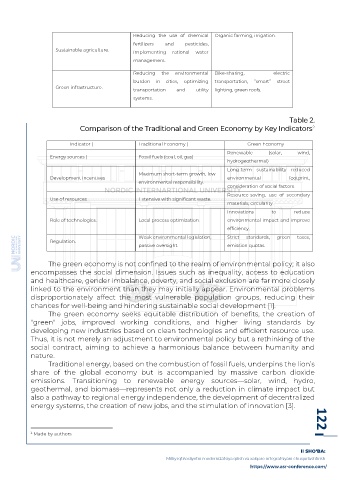
                                                                                                       Table 2.
                             Comparison of the Traditional and Green Economy by Key Indicators
                                                                                                               2

                          Indicator |             Traditional Economy |                 Green Economy
                                                                                 Renewable     (solar,    wind,
                   Energy sources |               Fossil fuels (coal, oil, gas)
                                                                                 hydrogeothermal)
                                                                                 Long-term  sustainability  reduced
                                                  Maximum short-term growth, low
                   Development incentives                                        environmental         footprint,
                                                  environmental responsibility.
                                                                                 consideration of social factors.
                                                                                 Resource-saving,  use  of  secondary
                   Use of resources               Extensive with significant waste.
                                                                                 materials, circularity.
                                                                                 Innovations    to      reduce
                   Role of technologies.          Local process optimization.    environmental impact and improve
                                                                                 efficiency.
                                                  Weak environmental legislation,   Strict   standards,   green   taxes,
                   Regulation.
                                                  passive oversight.             emission quotas.

                  The green economy is not confined to the realm of environmental policy; it also
            encompasses the social dimension. Issues such as inequality, access to education
            and healthcare, gender imbalance, poverty, and social exclusion are far more closely
            linked to the environment than they may initially appear. Environmental problems
            disproportionately  affect  the  most  vulnerable  population  groups,  reducing  their
            chances for well-being and hindering sustainable social development [1].
                  The  green  economy  seeks  equitable  distribution  of  benefits,  the  creation  of
            "green"  jobs,  improved  working  conditions,  and  higher  living  standards  by
            developing new industries based on clean technologies and efficient resource use.
            Thus, it is not merely an adjustment to environmental policy but a rethinking of the
            social  contract,  aiming  to  achieve  a  harmonious  balance  between  humanity  and
            nature.
                  Traditional energy, based on the combustion of fossil fuels, underpins the lion’s
            share  of  the  global  economy  but  is  accompanied  by  massive  carbon  dioxide
            emissions.  Transitioning  to  renewable  energy  sources—solar,  wind,  hydro,
            geothermal, and biomass—represents not only a reduction in climate impact but
            also a pathway to regional energy independence, the development of decentralized
            energy systems, the creation of new jobs, and the stimulation of innovation [3].


                                                                                                                122
            2  Made by authors

                                                                                                           II SHO‘BA:

                                                           Milliy iqtisodiyotni modernizatsiya qilish va xalqaro integratsiyani chuqurlashtirish

                                                                                         https://www.asr-conference.com/

