


Page 340 - “O‘ZBEKISTON – 2030 STRATEGIYASI: AMALGA OSHIRILAYOTGAN ISLOHOTLAR TAHLILI, MUAMMOLAR VA YECHIMLAR”
P. 340
Scientific
                                                            creativity
                                                          Continuous
                                     Competenci            learning              Business
                                        es                                        models

                                                           Continuous
                                                            learning


                                                           Informational

                                                          Telecommunicatio      Production        Digital
                   Innovative       Technologies               ns                                 Economy
                   environmen           и
                      t
                                                            Production


                                                            Digital data


                                                            Intellectual      Products/servi
                                      Content                property            ces


                                                            Information
                                                             resources

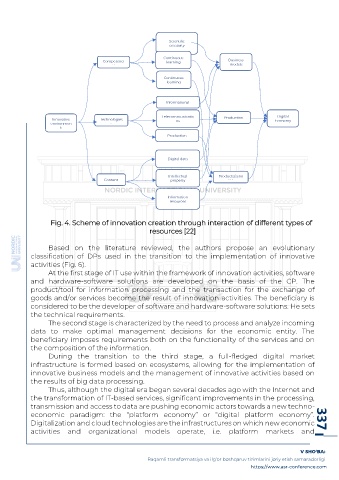
                   Fig. 4. Scheme of innovation creation through interaction of different types of
                                                      resources [22]

                  Based  on  the  literature  reviewed,  the  authors  propose  an  evolutionary
            classification  of  DPs  used  in  the  transition  to  the  implementation  of  innovative
            activities (Fig. 6).
                  At the first stage of IT use within the framework of innovation activities, software
            and  hardware-software  solutions  are  developed  on  the  basis  of  the  CP.  The
            product/tool  for  information  processing  and  the  transaction  for  the  exchange  of
            goods and/or services become the result of innovation activities. The beneficiary is
            considered to be the developer of software and hardware-software solutions. He sets
            the technical requirements.
                  The second stage is characterized by the need to process and analyze incoming
            data  to  make  optimal  management  decisions  for  the  economic  entity.  The
            beneficiary imposes requirements both on the functionality of the services and on
            the composition of the information.
                  During  the  transition  to  the  third  stage,  a  full-fledged  digital  market
            infrastructure is formed based on ecosystems, allowing for the implementation of
            innovative business models and the management of innovative activities based on
            the results of big data processing.
                  Thus, although the digital era began several decades ago with the Internet and
            the transformation of IT-based services, significant improvements in the processing,
            transmission and access to data are pushing economic actors towards a new techno-
            economic  paradigm:  the  “platform  economy”  or  “digital  platform  economy”.
            Digitalization and cloud technologies are the infrastructures on which new economic                 337
            activities  and  organizational  models  operate,  i.e.  platform  markets  and

                                                                                                           V SHO‘BA:

                                                     Raqamli transformatsiya va ilg‘or boshqaruv tizimlarini joriy etish samaradorligi

                                                                                         https://www.asr-conference.com

