


Page 104 - "Green Investments and financial technologies: opportunities and challenges for Uzbekistan" International Scientific and Practical Conference
P. 104
“Yashil investitsiyalar va moliyaviy texnologiyalar: O‘zbekiston uchun imkoniyatlar va muammolar” mavzusida xalqaro
                                    ilmiy-amaliy anjuman materiallari to‘plami (Toshkent, JIDU, 2025-yil 7-may)


                         1. Rationale for Green Economy Transition

                         Uzbekistan faces critical environmental challenges. The rapid retreat of the
                  Aral  Sea,  desertification,  and  the  over-exploitation  of  water  resources  threaten
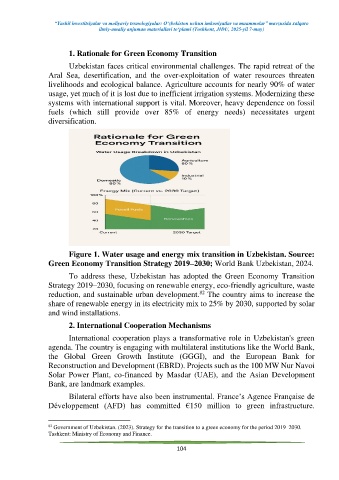
                  livelihoods and ecological balance. Agriculture accounts for nearly 90% of water
                  usage, yet much of it is lost due to inefficient irrigation systems. Modernizing these
                  systems with international support is vital. Moreover, heavy dependence on fossil
                  fuels  (which  still  provide  over  85%  of  energy  needs)  necessitates  urgent
                  diversification.


                         Figure 1. Water usage and energy mix transition in Uzbekistan. Source:
                  Green Economy Transition Strategy 2019–2030; World Bank Uzbekistan, 2024.

                         To  address  these,  Uzbekistan  has  adopted  the  Green  Economy  Transition
                  Strategy 2019–2030, focusing on renewable energy, eco-friendly agriculture, waste
                                                                       82
                  reduction, and sustainable urban development.  The country aims to increase the
                  share of renewable energy in its electricity mix to 25% by 2030, supported by solar
                  and wind installations.
                         2. International Cooperation Mechanisms

                         International cooperation plays a transformative role in Uzbekistan's green
                  agenda. The country is engaging with multilateral institutions like the World Bank,
                  the  Global  Green  Growth  Institute  (GGGI),  and  the  European  Bank  for
                  Reconstruction and Development (EBRD). Projects such as the 100 MW Nur Navoi
                  Solar  Power  Plant,  co-financed  by  Masdar  (UAE),  and  the  Asian  Development
                  Bank, are landmark examples.

                         Bilateral efforts have also been instrumental. France’s Agence Française de
                  Développement  (AFD)  has  committed  €150  million  to  green  infrastructure.


                  82  Government of Uzbekistan. (2023). Strategy for the transition to a green economy for the period 2019–2030.
                  Tashkent: Ministry of Economy and Finance.

                                                               104

