


Page 636 - RAQAMLI TRANSFORMATSIYA DAVRIDA PEDAGOGIK TA’LIMNI RIVOJLANTIRISH ISTIQBOLLARI
P. 636
structured  around  three  key  components.  A  qualitative  approach  was  used  to
            examine real-world applications of digital technologies in preschool settings.
                   Case  studies  were  selected  from  digitally  progressive  preschool  institutions
            across different regions. The selection criteria included:
                      -  integration of digital tools in the curriculum;
                      -  teacher digital training programs;
                      -  positive outcomes documented in student learning and engagement.
                   Data were gathered through observational reports, institutional documents,
            and  interviews  with  teachers  and  administrators.  Thematic  analysis  was  used  to
            identify recurring patterns and best practices in digital implementation.
                   Strategic approaches to digital integration
                   Integrating  technology  must  align  with  educational  goals,  not  replace
            traditional play. Digital content should be age-appropriate, interactive, and support
            developmental milestones.
                   Teacher training and digital literacy
                   Teachers play a central role. Strategic integration requires:
                   - ongoing digital pedagogy training;
                   - support systems for implementation;
                   - communities of practice for knowledge sharing.
                   Infrastructure and Accessibility
                   Adequate hardware, internet access, and technical support are critical. Equity
            in access must be ensured across urban and rural settings.
                   Innovations in preschool digital education
                      •  Interactive  applications  help  develop  literacy,  numeracy,  and  problem-
                          solving  skills.  Examples:  Khan  Academy  Kids,  ABCmouse,  Montessori
                          apps.
                      •  Emerging tools like AR storybooks or VR nature tours enhance experiential
                          learning without replacing physical play.
                      •  Tools like Bee-Bot or Cubetto introduce logical thinking and sequencing
                          to young learners in playful formats.
                      •  Children can co-create digital stories using voice, drawing, and animation
                          tools, fostering creativity and communication skills.
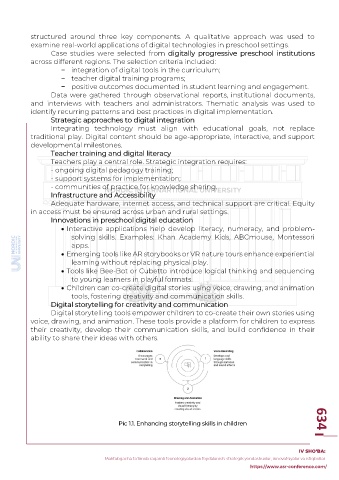
                   Digital storytelling for creativity and communication
                   Digital storytelling tools empower children to co-create their own stories using
            voice, drawing, and animation. These tools provide a platform for children to express
            their  creativity,  develop  their  communication  skills,  and  build  confidence  in  their
            ability to share their ideas with others.


                                           Pic 1.1. Enhancing storytelling skills in children                   634


                                                                                                          IV SHO‘BA:

                                      Maktabgacha ta’limda raqamli texnologiyalardan foydalanish: strategik yondashuvlar, innovatsiyalar va istiqbollar

                                                                                         https://www.asr-conference.com/

