


Page 905 - RAQAMLI TRANSFORMATSIYA DAVRIDA PEDAGOGIK TA’LIMNI RIVOJLANTIRISH ISTIQBOLLARI
P. 905
Engineering Modeling
                  At the design stage, the engineering modeling method was used to analyze the
            structural elements of the system and their interactions in advance. This approach
            allowed for the optimization of component dimensions and parameters, ensuring
            mechanical  and  electrical  compatibility.  In  addition,  the  hydrodynamic
            characteristics of the water dispensing system—such as liquid flow rate, pressure,
            and volume—were simulated, helping to refine the system’s technical specifications
            and select the most efficient design solutions.
                  Prototyping (Model Construction)
                  The initial physical prototype of the system was created through prototyping.
            At this stage, sensors, motors, relays, tubes, and control modules were integrated to
            assemble a functional mock-up and test its operability. Various design options were
            evaluated  to  improve  the  device’s  ergonomics  and  user  convenience.  Identified
            shortcomings  during  the  prototyping  phase  were  addressed  through  design
            adjustments, leading to an improved version of the system.
                  Experimental Research
                  The system’s performance and efficiency were verified experimentally. During
            this  phase,  its  continuous  operating  time  was  determined,  and  the  long-term
            reliability of components was assessed. Power consumption was measured using a
            9V  battery  and  alternative  power  sources.  The  system  was  tested  in  different
            environments  such  as  homes,  offices,  and  industrial  spaces  to  evaluate  sensor
            sensitivity and water flow rate.

                   RESEARCH FINDINGS
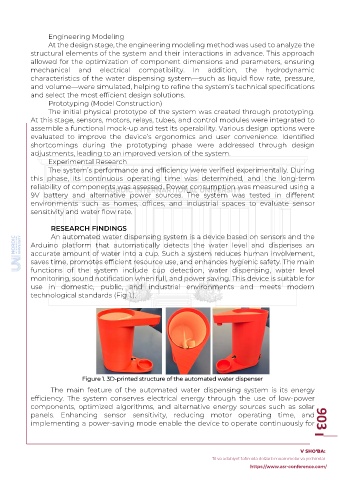
                   An automated water dispensing system is a device based on sensors and the
            Arduino  platform  that  automatically  detects  the  water  level  and  dispenses  an
            accurate amount of water into a cup. Such a system reduces human involvement,
            saves time, promotes efficient resource use, and enhances hygienic safety. The main
            functions  of  the  system  include  cup  detection,  water  dispensing,  water  level
            monitoring, sound notification when full, and power saving. This device is suitable for
            use  in  domestic,  public,  and  industrial  environments  and  meets  modern
            technological standards (Fig 1.).


                              Figure 1. 3D-printed structure of the automated water dispenser

                   The  main  feature  of  the  automated  water  dispensing  system  is  its  energy
            efficiency.  The  system  conserves  electrical  energy  through  the  use  of  low-power
            components,  optimized  algorithms,  and  alternative  energy  sources  such  as  solar
            panels.  Enhancing  sensor  sensitivity,  reducing  motor  operating  time,  and
            implementing a power-saving mode enable the device to operate continuously for                      903


                                                                                                           V SHO‘BA:

                                                                           Til va adabiyot ta’limida dolzarb muammolar va yechimlar

                                                                                         https://www.asr-conference.com/

