


Page 906 - RAQAMLI TRANSFORMATSIYA DAVRIDA PEDAGOGIK TA’LIMNI RIVOJLANTIRISH ISTIQBOLLARI
P. 906
extended periods. As a result, the energy consumption per cycle remains at 0.03 Wh,
            allowing a 9 V battery to function for up to 48 hours.
                   Energy efficiency practices and methods
                   The  results  of  engineering  modeling  made  it  possible  to  identify  the  main
            structural characteristics of the automated water dispenser system and ensure the
            compatibility of its components. The calculations and simulations conducted refined
            the operating parameters of the device and increased its efficiency. As a result of
            liquid  flow  modeling,  the  water  dispensing  time  was  optimized  to  3–5  seconds.
            Moreover, the motor was able to maintain a steady pressure within the 9–12 V power
            range, and the control signal delay between the sensor and the motor was reduced
            to only 50 milliseconds. These parameters ensured reliable and fast system operation,
            energy savings, and user convenience.
                   The  prototyping  phase  provided  an  opportunity  to  test  the  practical
            functionality  of  the  automated  water  dispensing  system  and  evaluate  the
            effectiveness of its technical solutions. Through the first prototype, the accuracy of
            cup detection reached 95%, demonstrating the system’s reliability. The connection
            and  disconnection  mechanisms  between  the  motor  and  relay  operated  precisely
            and  consistently,  ensuring  the  uninterrupted  performance  of  the  main  functions.
            Consequently,  the  complete  automation  of  the  water  dispensing  process  was
            successfully achieved without any direct user intervention. These results confirmed
            that  the  device  meets  modern  technological  standards  and  is  suitable  for  both
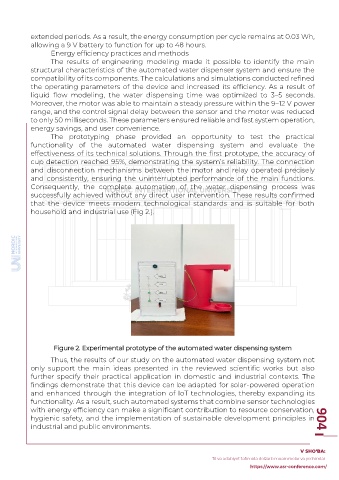
            household and industrial use (Fig 2.).


                    Figure 2. Experimental prototype of the automated water dispensing system
                   Thus, the results of our study on the automated water dispensing system not
            only  support  the  main  ideas  presented  in  the  reviewed  scientific  works  but  also
            further  specify  their  practical  application  in  domestic  and  industrial  contexts.  The
            findings demonstrate that this device can be adapted for solar-powered operation
            and enhanced through the integration of IoT technologies, thereby expanding its
            functionality. As a result, such automated systems that combine sensor technologies
            with energy efficiency can make a significant contribution to resource conservation,
            hygienic safety, and the implementation of sustainable development principles in                    904
            industrial and public environments.


                                                                                                           V SHO‘BA:

                                                                           Til va adabiyot ta’limida dolzarb muammolar va yechimlar

                                                                                         https://www.asr-conference.com/

