


Page 127 - XORIJIY TILLARNI O‘QITISH VA TARJIMA SOHASIDA SUN’IY INTELLEKTDAN SAMARALI FOYDALANISHNING ZAMONAVIY TENDENSIYALARI
P. 127
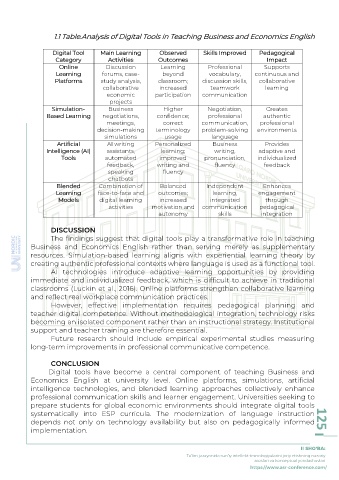
1.1 Table.Analysis of Digital Tools in Teaching Business and Economics English

                   Digital Tool     Main Learning        Observed       Skills Improved     Pedagogical
                     Category          Activities        Outcomes                              Impact
                      Online          Discussion         Learning         Professional        Supports
                     Learning        forums, case-        beyond          vocabulary,     continuous and
                    Platforms       study analysis,      classroom;     discussion skills,   collaborative
                                     collaborative       increased         teamwork           learning
                                       economic        participation    communication
                                       projects
                   Simulation-         Business           Higher          Negotiation,         Creates
                 Based Learning      negotiations,      confidence;       professional       authentic
                                      meetings,           correct       communication,      professional
                                   decision‑making      terminology     problem-solving    environments
                                      simulations          usage           language
                     Artificial        AI writing      Personalized         Business          Provides
                 Intelligence (AI)    assistants,        learning;          writing,        adaptive and
                       Tools          automated          improved        pronunciation,    individualized
                                       feedback,        writing and         fluency           feedback
                                       speaking           fluency
                                       chatbots
                     Blended        Combination of       Balanced        Independent         Enhances
                     Learning      face-to-face and      outcomes;          learning,       engagement
                     Models         digital learning     increased         integrated         through
                                       activities     motivation and    communication       pedagogical
                                                         autonomy             skills         integration

                   DISCUSSION
                   The findings suggest that digital tools play a transformative role in teaching
            Business  and  Economics  English  rather  than  serving  merely  as  supplementary
            resources.  Simulation-based  learning  aligns  with  experiential  learning  theory  by
            creating authentic professional contexts where language is used as a functional tool.
                   AI  technologies  introduce  adaptive  learning  opportunities  by  providing
            immediate  and  individualized  feedback,  which is  difficult  to  achieve  in  traditional
            classrooms (Luckin et al., 2016). Online platforms strengthen collaborative learning
            and reflect real workplace communication practices.
                   However,  effective  implementation  requires  pedagogical  planning  and
            teacher digital competence. Without methodological integration, technology risks
            becoming an isolated component rather than an instructional strategy. Institutional
            support and teacher training are therefore essential.
                   Future  research  should  include  empirical  experimental  studies  measuring
            long-term improvements in professional communicative competence.

                   CONCLUSION
                  Digital  tools  have  become  a  central  component  of  teaching  Business  and
            Economics  English  at  university  level.  Online  platforms,  simulations,  artificial
            intelligence  technologies,  and  blended  learning  approaches  collectively  enhance
            professional communication skills and learner engagement. Universities seeking to
            prepare students for global economic environments should integrate digital tools
            systematically  into  ESP  curricula.  The  modernization  of  language  instruction
            depends  not  only  on  technology  availability  but  also  on  pedagogically  informed            125
            implementation.


                                                                                                           II SHO‘BA:

                                                                   Ta’lim jarayonida sun’iy intellekt texnologiyalarini joriy etishning nazariy
                                                                                          asoslari va konseptual yondashuvlari
                                                                                         https://www.asr-conference.com/

