


Page 85 - XORIJIY TILLARNI O‘QITISH VA TARJIMA SOHASIDA SUN’IY INTELLEKTDAN SAMARALI FOYDALANISHNING ZAMONAVIY TENDENSIYALARI
P. 85
The  research  objectives  are  threefold:  (1)  to  identify  dominant  conceptual
            metaphors in male- and female-targeted advertisements in both languages; (2) to
            analyze frame structures that organize gender-related advertising content; and (3) to
            determine  cross-linguistic  similarities  and  differences  in  cognitive  gender
            representation strategies.

                   MATERIALS AND METHODS
                   2.1 Corpus Description
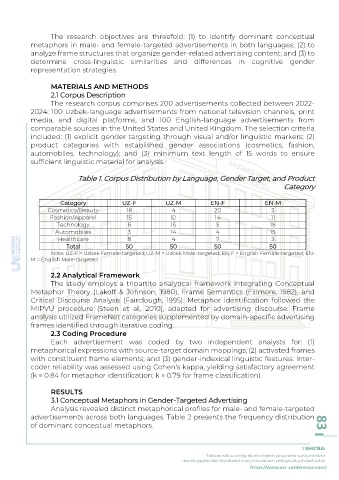
                   The research corpus comprises 200 advertisements collected between 2022-
            2024: 100 Uzbek-language advertisements from national television channels, print
            media,  and  digital  platforms,  and  100  English-language  advertisements  from
            comparable sources in the United States and United Kingdom. The selection criteria
            included:  (1)  explicit  gender targeting  through  visual  and/or  linguistic  markers;  (2)
            product  categories  with  established  gender  associations  (cosmetics,  fashion,
            automobiles,  technology);  and  (3)  minimum  text  length  of  15  words  to  ensure
            sufficient linguistic material for analysis.

                            Table 1. Corpus Distribution by Language, Gender Target, and Product
                                                                                                     Category

                      Category              UZ-F           UZ-M            EN-F               EN-M
                  Cosmetics/Beauty           18              4              20                  3
                   Fashion/Apparel            15             12             14                  11
                     Technology               6              16              5                  18
                    Automobiles               3              14              4                  15
                     Healthcare               8              4               7                  3
                        Total                50              50             50                  50
                   Note: UZ-F = Uzbek Female-targeted; UZ-M = Uzbek Male-targeted; EN-F = English Female-targeted; EN-
            M = English Male-targeted

                   2.2 Analytical Framework
                   The  study  employs  a  tripartite  analytical  framework  integrating  Conceptual
            Metaphor  Theory  (Lakoff  &  Johnson,  1980),  Frame  Semantics  (Fillmore,  1982),  and
            Critical  Discourse  Analysis  (Fairclough,  1995).  Metaphor  identification  followed  the
            MIPVU  procedure  (Steen  et  al.,  2010),  adapted  for  advertising  discourse.  Frame
            analysis utilized FrameNet categories supplemented by domain-specific advertising
            frames identified through iterative coding.
                   2.3 Coding Procedure
                   Each  advertisement  was  coded  by  two  independent  analysts  for:  (1)
            metaphorical expressions with source-target domain mappings; (2) activated frames
            with constituent frame elements; and (3) gender-indexical linguistic features. Inter-
            coder reliability was assessed using Cohen's kappa, yielding satisfactory agreement
            (k = 0.84 for metaphor identification; k = 0.79 for frame classification).

                   RESULTS
                   3.1 Conceptual Metaphors in Gender-Targeted Advertising
                   Analysis revealed distinct metaphorical profiles for male- and female-targeted
            advertisements across both languages. Table 2 presents the frequency distribution
            of dominant conceptual metaphors.                                                                   83


                                                                                                           I SHO‘BA:

                                                                         Tilshunoslik va xorijiy tillarni o‘qitish jarayonida sun’iy intellekt
                                                                 texnologiyalaridan foydalanishning innovatsion pedagogik yondashuvlari
                                                                                         https://www.asr-conference.com/

