


Page 87 - XORIJIY TILLARNI O‘QITISH VA TARJIMA SOHASIDA SUN’IY INTELLEKTDAN SAMARALI FOYDALANISHNING ZAMONAVIY TENDENSIYALARI
P. 87
CARE                    32               12              28               8
                     ACHIEVEMENT                  12              24               14              28
                     RELATIONSHIP                  6               8               7                8
                   Note:  Values  represent  raw  frequencies;  multiple  frames  may  be  activated  within  a  single
            advertisement.

                   3.3 Cross-Linguistic Comparison
                   Chi-square  analysis  revealed  no  statistically  significant  differences  between
            Uzbek  and  English  advertisements  in  metaphor  distribution  for  female-targeted
            content (X² = 3.42, p > 0.05) or male-targeted content (X² = 2.87, p > 0.05). This suggests
            universal cognitive patterns in gender representation across these linguistically and
            culturally distinct advertising traditions.
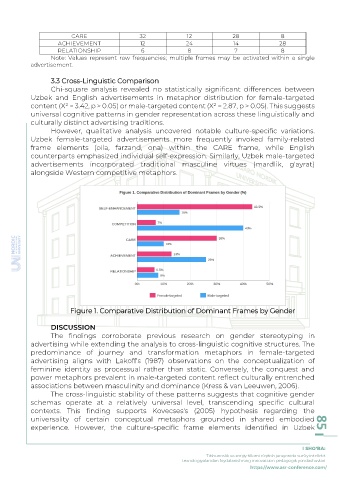
                   However,  qualitative  analysis  uncovered  notable  culture-specific  variations.
            Uzbek  female-targeted  advertisements  more  frequently  invoked  family-related
            frame  elements  (oila,  farzand,  ona)  within  the  CARE  frame,  while  English
            counterparts emphasized individual self-expression. Similarly, Uzbek male-targeted
            advertisements  incorporated  traditional  masculine  virtues  (mardlik,  g'ayrat)
            alongside Western competitive metaphors.


                          Figure 1. Comparative Distribution of Dominant Frames by Gender

                   DISCUSSION
                   The  findings  corroborate  previous  research  on  gender  stereotyping  in
            advertising while extending the analysis to cross-linguistic cognitive structures. The
            predominance  of  journey  and  transformation  metaphors  in  female-targeted
            advertising  aligns  with  Lakoff's  (1987)  observations  on  the  conceptualization  of
            feminine  identity  as  processual  rather  than  static.  Conversely,  the  conquest  and
            power metaphors prevalent in male-targeted content reflect culturally entrenched
            associations between masculinity and dominance (Kress & van Leeuwen, 2006).
                   The cross-linguistic stability of these patterns suggests that cognitive gender
            schemas  operate  at  a  relatively  universal  level,  transcending  specific  cultural
            contexts.  This  finding  supports  Kovecses's  (2005)  hypothesis  regarding  the
            universality  of  certain  conceptual  metaphors  grounded  in  shared  embodied
            experience.  However,  the  culture-specific  frame  elements  identified  in  Uzbek                85


                                                                                                           I SHO‘BA:

                                                                         Tilshunoslik va xorijiy tillarni o‘qitish jarayonida sun’iy intellekt
                                                                 texnologiyalaridan foydalanishning innovatsion pedagogik yondashuvlari
                                                                                         https://www.asr-conference.com/

