


Page 91 - XORIJIY TILLARNI O‘QITISH VA TARJIMA SOHASIDA SUN’IY INTELLEKTDAN SAMARALI FOYDALANISHNING ZAMONAVIY TENDENSIYALARI
P. 91
⎯  Slight vowel lengthening
               ⎯  Limited pitch elevation
                   However,  it  rarely  serves  a  lexical  contrastive  function.  Minimal  pairs
            distinguished solely by stress are uncommon. Therefore, stress operates primarily as
            a rhythmic and structural marker rather than as a semantic differentiator.


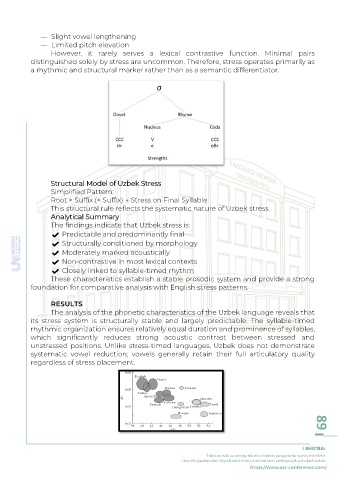
                   Structural Model of Uzbek Stress
                   Simplified Pattern:
                   Root + Suffix (+ Suffix) → Stress on Final Syllable
                   This structural rule reflects the systematic nature of Uzbek stress.
                   Analytical Summary
                   The findings indicate that Uzbek stress is:
                   ✔ Predictable and predominantly final
                   ✔ Structurally conditioned by morphology
                   ✔ Moderately marked acoustically
                   ✔ Non-contrastive in most lexical contexts
                   ✔ Closely linked to syllable-timed rhythm
                   These characteristics establish a stable prosodic system and provide a strong
            foundation for comparative analysis with English stress patterns.

                   RESULTS
                   The analysis of the phonetic characteristics of the Uzbek language reveals that
            its  stress  system  is  structurally  stable  and  largely  predictable.  The  syllable-timed
            rhythmic organization ensures relatively equal duration and prominence of syllables,
            which  significantly  reduces  strong  acoustic  contrast  between  stressed  and
            unstressed positions. Unlike stress-timed languages, Uzbek does not demonstrate
            systematic  vowel  reduction;  vowels  generally  retain  their  full  articulatory  quality
            regardless of stress placement.


                                                                                                                89
                                                                                                           I SHO‘BA:

                                                                         Tilshunoslik va xorijiy tillarni o‘qitish jarayonida sun’iy intellekt
                                                                 texnologiyalaridan foydalanishning innovatsion pedagogik yondashuvlari
                                                                                         https://www.asr-conference.com/

