


Page 94 - XORIJIY TILLARNI O‘QITISH VA TARJIMA SOHASIDA SUN’IY INTELLEKTDAN SAMARALI FOYDALANISHNING ZAMONAVIY TENDENSIYALARI
P. 94
conceptualized through metaphorical structures embedded in language. Similarly,
            Anna  Wierzbicka  emphasizes  that  emotional  concepts  vary  significantly  across
            cultures,  and  each  language  possesses  unique  semantic  structures  to  describe
            emotional states.
                   Research on English and Uzbek languages also confirms the importance of
            cultural factors in shaping emotional vocabulary. For instance, studies indicate that
            expressions  related  to  happiness  in  Uzbek  often  emphasize  social  harmony  and
            family well-being, while English expressions tend to focus on personal satisfaction
            and individual emotions.
                   In addition, comparative linguistic research highlights that idioms, proverbs,
            and metaphorical expressions serve as important indicators of cultural perceptions
            of happiness. Linguistic analyses of proverbs and folklore reveal that happiness in
            Uzbek culture is frequently associated with fate, luck, and collective well-being. These
            studies  demonstrate  that  the  linguistic  representation  of  happiness  reflects  both
            universal emotional experience and culture-specific conceptualizations.

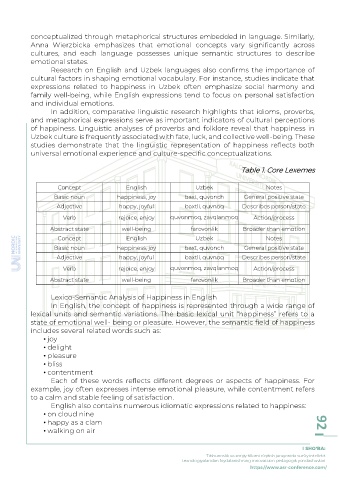
                                                                                      Table 1. Core Lexemes

                     Concept                 English                  Uzbek                   Notes
                    Basic noun            happiness, joy          baxt, quvonch        General positive state
                     Adjective             happy, joyful          baxtli, quvnoq      Describes person/state

                       Verb                rejoice, enjoy    quvonmoq, zavqlanmoq         Action/process
                   Abstract state           well-being              farovonlik        Broader than emotion

                     Concept                 English                  Uzbek                   Notes
                    Basic noun            happiness, joy          baxt, quvonch        General positive state
                     Adjective             happy, joyful          baxtli, quvnoq      Describes person/state
                       Verb                rejoice, enjoy    quvonmoq, zavqlanmoq         Action/process

                   Abstract state           well-being              farovonlik        Broader than emotion

                   Lexico-Semantic Analysis of Happiness in English
                   In English, the concept of happiness is represented through a wide range of
            lexical  units  and  semantic  variations.  The  basic  lexical  unit  “happiness” refers  to  a
            state of emotional well- being or pleasure. However, the semantic field of happiness
            includes several related words such as:
                • joy
                • delight
                • pleasure
                • bliss
                • contentment
                   Each  of  these  words  reflects  different  degrees  or  aspects  of  happiness.  For
            example, joy often expresses intense emotional pleasure, while contentment refers
            to a calm and stable feeling of satisfaction.
                   English also contains numerous idiomatic expressions related to happiness:
                • on cloud nine
                • happy as a clam                                                                               92
                • walking on air

                                                                                                           I SHO‘BA:

                                                                         Tilshunoslik va xorijiy tillarni o‘qitish jarayonida sun’iy intellekt
                                                                 texnologiyalaridan foydalanishning innovatsion pedagogik yondashuvlari
                                                                                         https://www.asr-conference.com/

