


Page 135 - JOJAPS_VOL15
P. 135
Masniati / JOJAPS – JOURNAL ONLINE JARINGAN PENGAJIAN SENI BINA

                                         Types of Teacher Talk           Total
                                         Accept Feelings                 20

                                         Praise and Encouragement        83
                                         Accepts or Uses ideas of Students   53
                                         Asking Questions
                                                                         170
                                         Lecturing                       89
                                         Giving Direction
                                                                         155
                                         Criticizing or justifying Authority
                                                                         25
                                         Student Talk Response
                                                                         198
                                         Student Talk Initiation
                                                                         35
                                         Silence or Pause or Confusion   20

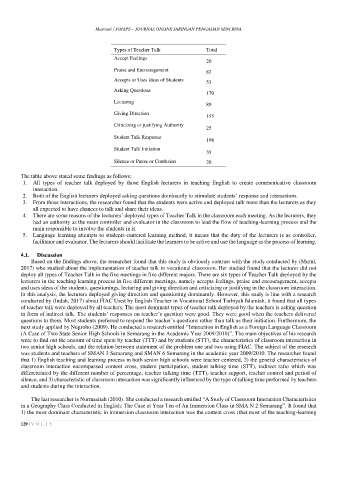
        The table above stated some findings as follows;
         1.  All  types  of  teacher  talk  deployed  by  those  English  lecturers  in  teaching  English  to  create  communicative  classroom
             interaction.
         2.  Both of the English lecturers deployed asking questions dominantly to stimulate students’ response and interactions.
         3.  From those interactions, the researcher found that the students were active and deployed talk more than the lecturers as they
             all expected to have chances to talk and share their ideas.
         4.  There are some reasons of the lecturers’ deployed types of Teacher Talk in the classroom each meeting. As the lecturers, they
             had an authority as the main controller and evaluator in the classroom to lead the flow of teaching-learning process and the
             main responsible to involve the students in it.
         5.  Language learning attempts to students-cantered learning method, it means that the duty of the lecturers is as controller,
             facilitator and evaluator. The lecturers should facilitate the learners to be active and use the language as the process of learning.

        4.1.   Discussion
            Based on the findings above, the researcher found that this study is obviously contrast with the study conducted by (Murni,
        2017) who studied about the implementation of teacher talk in vocational classroom. Her studied found that the lecturer did not
        deploy all types of Teacher Talk in the five meetings in five different majors. There are six types of Teacher Talk deployed by the
        lecturers in the teaching learning process in five different meetings, namely accepts feelings, praise and encouragement, accepts
        and uses ideas of the students, questionings, lecturing and giving direction and criticizing or justifying in the classroom interaction.
        In this analysis, the lecturers deployed giving direction and questioning dominantly. However, this study is line with a research
        conducted by (Indah, 2017) about FIAC Used by English Teacher in Vocational School Tarbiyah Islamiah, it found that all types
        of teacher talk were deployed by all teachers. The most dominant types of teacher talk deployed by the teachers is asking question
        in form of indirect talk. The students’ responses on teacher’s question were good. They were good when the teachers delivered
        questions to them. Most students preferred to respond the teacher’s questions rather than talk as their initiation. Furthermore, the
        next study applied by Nugroho (2009). He conducted a research entitled “Interaction in English as a Foreign Language Classroom
        (A Case of Two State Senior High Schools in Semarang in the Academic Year 2009/2010)”. The main objectives of his research
        were to find out the amount of time spent by teacher (TTT) and by students (STT), the characteristics of classroom interaction in
        two senior high schools, and the relation between statement of the problem one and two using FIAC. The subject of the research
        was students and teachers of SMAN 3 Semarang and SMAN 6 Semarang in the academic year 2009/2010. The researcher found
        that 1) English teaching and learning process in both senior high schools were teacher centered, 2) the general characteristics of
        classroom  interaction  encompassed  content  cross,  student  participation,  student  talking  time  (STT),  indirect  ratio  which  was
        differentiated by the different number of percentage, teacher talking time (TTT), teacher support, teacher control and period of
        silence, and 3) characteristic of classroom interaction was significantly influenced by the type of talking time performed by teachers
        and students during the interaction.

            The last researcher is Nurmasitah (2010). She conducted a research entitled “A Study of Classroom Interaction Characteristics
        in a Geography Class Conducted in English: The Case at Year Ten of An Immersion Class in SMA N 2 Semarang”. It found that
        1) the most dominant characteristic in immersion classroom interaction was the content cross (that most of the teaching-learning
        129 | V O L 1 5

