


Page 49 - J0JAPS_VOL14
P. 49
Mohd Sarhan  / JOJAPS – JOURNAL ONLINE JARINGAN PENGAJIAN SENI BINA 0194955501
              3.   Cover areas with both high and low occupant density.
              4.   The  sampling  probe  should  be  located  between  75  and  120cm  from  the  floor  and  the  centre  of  the  room  or  an
                  occupied zone (COP).
              5.   At least 0.5m from corners or windows.
              6.   At least 0.5m from walls, partitions and other vertical surfaces (e.g. file carbinet).
              7.   Not  directly  in  front  of  air  supply  diffusers,  induction  units,  floor  fans,  or  heaters,  or  the  exhaled  breath  of  the
                  occupant.


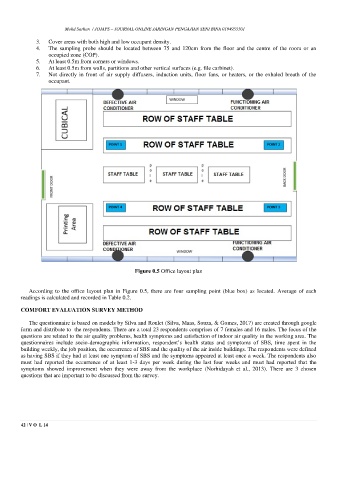
                                                Figure 0.5 Office layout plan


           According  to  the  office  layout  plan  in  Figure  0.5,  there  are  four  sampling  point  (blue  box)  as  located.  Average  of  each
        readings is calculated and recorded in Table 0.2.

        COMFORT EVALUATION SURVEY METHOD

           The questionnaire is based on models by Silva and Roulet (Silva, Maas, Souza, & Gomes, 2017) are created through google
        form and distribute to  the respondents. There are a total 23 respondents comprises of 7 females and 16 males. The focus of the
        questions are related to the air quality problems, health symptoms and satisfaction of indoor air quality in the working area. The
        questionnaires  include  socio-demographic  information,  respondent’s  health  status  and  symptoms  of  SBS,  time  spent  in  the
        building weekly, the job position, the occurrence of SBS and the quality of the air inside buildings. The respondents were defined
        as having SBS if they had at least one symptom of SBS and the symptoms appeared at least once a week. The respondents also
        must  had  reported  the  occurrence  of  at  least  1-3  days  per  week  during  the  last  four  weeks  and  must  had  reported  that  the
        symptoms  showed  improvement  when  they  were  away  from  the  workplace  (Norhidayah  et  al.,  2013).  There  are  3  chosen
        questions that are important to be discussed from the survey.


        42 | V O  L 14

