


Page 88 - J0JAPS_VOL14
P. 88
Fathan Mubina Dewadi  / JOJAPS – JOURNAL ONLINE JARINGAN PENGAJIAN SENI BINA

                                  Table 4. Results of Calculations in Material HK-40 horizontal conditions

                                         No    Parameter           Space
                                              Calculation   100 m   200 m   300 m
                                         1       t (s)      19      28      38
                                         2      v (m/s)     5,5    7,14     7,89
                                                     2
                                         3      a (m/s )   0,29    0,255    0,21
                                         4      F Ia  (N)   29,09   25,59   21,07
                                         5      F m  (N)   24,61   24,61   24,61
                                         6      F ad  (N)   0,513   0,86    1,06
                                         7      F t  (N)   54,21   51,06   46,74
                                         8      τ (Nm)     11,71   11,029   10,09
                                         9     P total  (W)   298,15   364,57   368,78

           And at uphill distances, the difference that occurs will be even greater if the incline is quite far. Explanation of the calculation
        of HK-40 material will be explained in Table 5.

                                    Table 5. Results of Calculation on Material HK-40 uphill conditions

                                         No   Parameter           Space
                                              Calculation   20 m   40 m    60 m
                                         1       t (s)      10      14      18
                                         2      v (m/s)     5,5    7,14    7,89
                                                    2
                                         3     a (m/s )    0,55    0,51    0,44
                                         4      F Ia  (N)   55,19   51,17   44,15
                                         5      F m  (N)   23,97   23,97   23,97
                                         6      F ad  (N)   0,513   0,86   1,06
                                         6      F ad  (N)   0,513   0,86   1,06
                                         7      F t  (N)   79,67    76     69,18
                                         8      τ (Nm)     17,49   16,69   15,22
                                         9     P total  (W)   438,19   542,64   545,83

           In the horizontal path and uphill road, between medium and long distances it has a slight difference in the speed value. So the
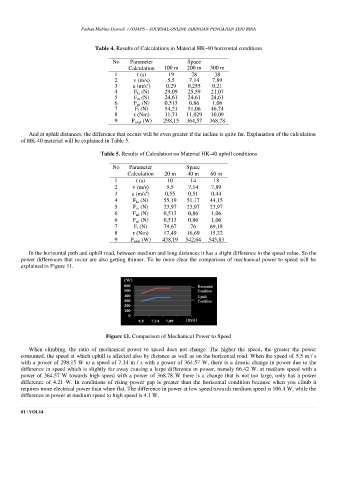
        power differences that occur are also getting thinner. To be more clear the comparison of mechanical power to speed will be
        explained in Figure 11.


                                      Figure 11. Comparison of Mechanical Power to Speed

           When  climbing,  the  ratio  of  mechanical  power  to  speed  does  not  change.  The  higher  the  speed,  the  greater  the  power
        consumed, the speed at which uphill is affected also by distance as well as on the horizontal road. When the speed of 5.5 m / s
        with a power of 298.15 W to a speed of 7.14 m / s with a power of 364.57 W, there is a drastic change in power due to the
        difference in speed which is slightly far away causing a large difference in power, namely 66.42 W. at medium speed with a
        power of 364.57 W towards high speed with a power of 368.78 W there is a change that is not too large, only has a power
        difference  of  4.21  W.  In  conditions  of  rising  power  gap  is  greater  than  the  horizontal  condition  because  when  you  climb  it
        requires more electrical power than when flat. The difference in power at low speed towards medium speed is 106.4 W, while the
        difference in power at medium speed to high speed is 4.1 W.


        81 | VOL14

