


Page 139 - Handout Computer Network.
P. 139
Computer Network                                                             2026


                 6.5.4 Static Route Operation


                    Static route operations can be summarized into a three-part sequence:

                       1. The network administrator configures the route.  2.
                       The router installs the route in the routing table.
                       3. Packets are routed using the static route.


                 6.5.5 Dynamic Routing Overview


                   Dynamic routing is necessary to allow networks to update and adapt quickly to changes.
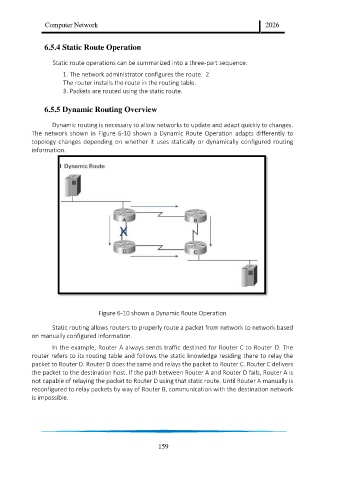
            The  network  shown  in  Figure  6-10 shown  a  Dynamic  Route  Operation  adapts  differently  to
            topology changes depending on whether it uses statically or dynamically configured routing
            information.


                                    Figure 6-10 shown a Dynamic Route Operation

                   Static routing allows routers to properly route a packet from network to network based
            on manually configured information.

                   In the example, Router A always sends traffic destined for Router C to Router D. The
            router refers to its routing table and follows the static knowledge residing there to relay the
            packet to Router D. Router D does the same and relays the packet to Router C. Router C delivers
            the packet to the destination host. If the path between Router A and Router D fails, Router A is
            not capable of relaying the packet to Router D using that static route. Until Router A manually is
            reconfigured to relay packets by way of Router B, communication with the destination network
            is impossible.


                                                         159

