


Page 140 - Handout Computer Network.
P. 140
Dynamic  routing  offers  more  flexibility.  According  to  the  routing  table  generated  by
                Router  A,  a  packet  can  reach  its  destination  over  the  preferred  route  through  Router  D.
                However, a second path to the destination is available by way of Router B.

                        When Router A recognizes that the link to Router D is down, it adjusts its routing table,
                making the path through Router B the preferred path to the destination. The routers continue
                sending packets over this link. When the path between Routers A and D is restored to service,
                Router A again can change its routing table to indicate a preference for the counterclockwise
                path through Routers D and C to the destination network.

                        Dynamic routing protocols also can direct traffic from the same session over different
                paths in a network for better performance. This is known as load sharing.
                     6.5.6 Dynamic Routing Operations


                        The success of dynamic routing depends on two basic router functions:


                           •  Maintenance of a routing table

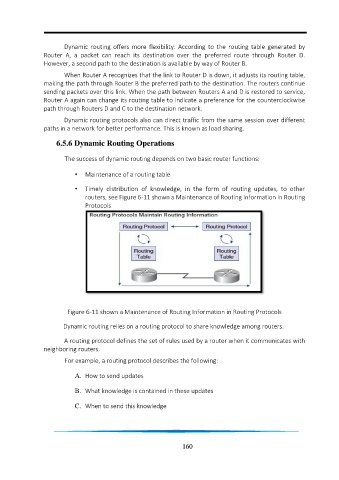
                           •  Timely  distribution  of  knowledge,  in  the  form  of  routing  updates,  to  other
                               routers, see Figure 6-11 shown a Maintenance of Routing Information in Routing
                               Protocols


                         Figure 6-11 shown a Maintenance of Routing Information in Routing Protocols

                       Dynamic routing relies on a routing protocol to share knowledge among routers.

                        A routing protocol defines the set of rules used by a router when it communicates with
                neighboring routers.
                        For example, a routing protocol describes the following:


                           A.  How to send updates

                           B.  What knowledge is contained in these updates

                           C.  When to send this knowledge


                                                                 160

