


Page 147 - Handout Computer Network.
P. 147
Computer Network                                                             2026


                  6.7.2.2   How Link-State Protocols Exchange Routing Information


                   Link-state network-discovery mechanisms are used to create a common picture of the
            entire network. All link-state routers share this view of the network. This is similar to having
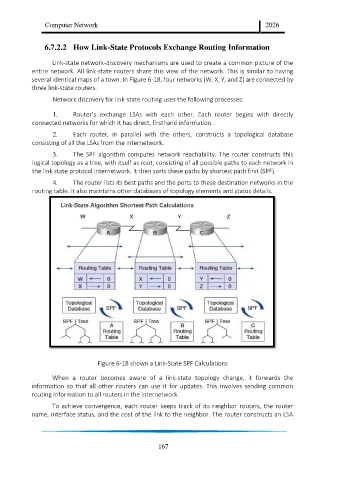
            several identical maps of a town. In Figure 6-18, four networks (W, X, Y, and Z) are connected by
            three link-state routers.
                    Network discovery for link-state routing uses the following processes:

                    1.     Router’s  exchange  LSAs  with  each  other.  Each  router  begins  with  directly
            connected networks for which it has direct, firsthand information.

                    2.     Each  router,  in  parallel  with  the  others,  constructs  a  topological  database
            consisting of all the LSAs from the internetwork.
                    3.     The  SPF  algorithm  computes  network  reachability.  The  router  constructs  this
            logical topology as a tree, with itself as root, consisting of all possible paths to each network in
            the link state protocol internetwork. It then sorts these paths by shortest path first (SPF).
                    4.     The router lists its best paths and the ports to these destination networks in the
            routing table. It also maintains other databases of topology elements and status details.


                                   Figure 6-18 shown a Link-State SPF Calculations

                   When  a  router  becomes  aware  of  a  link-state  topology  change,  it  forwards  the
            information  so  that  all other  routers can  use  it  for  updates.  This  involves  sending  common
            routing information to all routers in the internetwork.
                   To  achieve  convergence,  each  router  keeps  track  of  its  neighbor routers,  the router
            name, interface status, and the cost of the link to the neighbor. The router constructs an LSA


                                                         167

