


Page 148 - Handout Computer Network.
P. 148
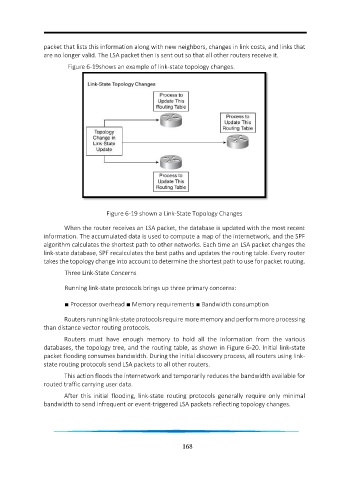
packet that lists this information along with new neighbors, changes in link costs, and links that
                are no longer valid. The LSA packet then is sent out so that all other routers receive it.

                          Figure 6-19shows an example of link-state topology changes.


                                      Figure 6-19 shown a Link-State Topology Changes

                        When the router receives an LSA packet, the database is updated with the most recent
                information. The accumulated data is used to compute a map of the internetwork, and the SPF
                algorithm calculates the shortest path to other networks. Each time an LSA packet changes the
                link-state database, SPF recalculates the best paths and updates the routing table. Every router
                takes the topology change into account to determine the shortest path to use for packet routing.
                        Three Link-State Concerns

                        Running link-state protocols brings up three primary concerns:


                        ■ Processor overhead ■ Memory requirements ■ Bandwidth consumption

                        Routers running link-state protocols require more memory and perform more processing
                than distance vector routing protocols.

                        Routers  must  have  enough  memory  to  hold  all  the  information  from  the  various
                databases, the topology tree, and the routing table, as shown in Figure 6-20. Initial link-state
                packet flooding consumes bandwidth. During the initial discovery process, all routers using link-
                state routing protocols send LSA packets to all other routers.

                        This action floods the internetwork and temporarily reduces the bandwidth available for
                routed traffic carrying user data.
                        After  this  initial  flooding,  link-state  routing  protocols  generally  require  only  minimal
                bandwidth to send infrequent or event-triggered LSA packets reflecting topology changes.


                                                                 168

