


Page 21 - Handout Computer Network.
P. 21
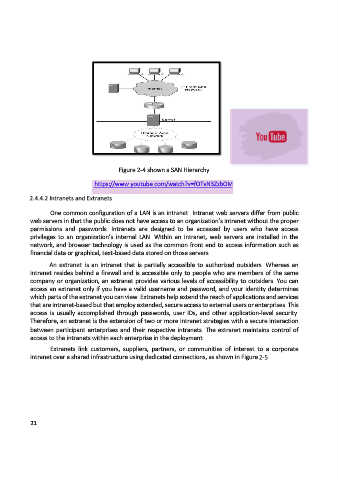
Figure 2-4 shown a SAN Hierarchy

                                   https://www.youtube.com/watch?v=fOTvN3ZzbOM

            2.4.4.2 Intranets and Extranets


                   One common configuration of a LAN is an intranet. Intranet web servers differ from public
            web servers in that the public does not have access to an organization’s intranet without the proper
            permissions  and  passwords.  Intranets  are  designed  to  be  accessed  by  users  who  have  access
            privileges  to  an  organization’s  internal  LAN.  Within  an  intranet,  web  servers  are  installed  in  the
            network, and browser technology is used as the common front end to access information such as
            financial data or graphical, text-based data stored on those servers.
                   An  extranet is an intranet that is partially accessible to authorized outsiders. Whereas an
            intranet resides behind a firewall and is accessible only to people who are members of the same
            company or organization, an extranet provides various levels of accessibility to outsiders. You can
            access an extranet only if you have a valid username and password, and your identity determines
            which parts of the extranet you can view. Extranets help extend the reach of applications and services
            that are intranet-based but that employ extended, secure access to external users or enterprises. This
            access  is  usually  accomplished  through  passwords,  user  IDs,  and  other application-level  security.
            Therefore, an extranet is the extension of two or more intranet strategies with a secure interaction
            between participant enterprises and their respective intranets. The extranet maintains control of
            access to the intranets within each enterprise in the deployment.
                   Extranets  link  customers,  suppliers,  partners,  or  communities  of  interest  to  a  corporate
            intranet over a shared infrastructure using dedicated connections, as shown in Figure 2-5.


            21

