


Page 246 - Handout Computer Network.
P. 246
•  Appends  to  the  front of  this  encrypted  quantity  a  field  called  “ESP  header”;  the  resulting
                 package is called the “enchilada”

                 • Creates an authentication MAC over the whole enchilada using the algorithm and key specified
                 in the SA
                 • Appends the MAC to the back of the enchilada forming the payload

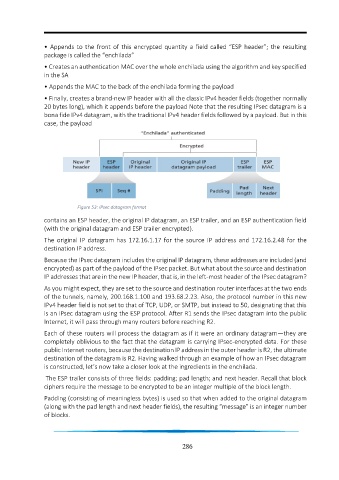
                 • Finally, creates a brand-new IP header with all the classic IPv4 header fields (together normally
                 20 bytes long), which it appends before the payload Note that the resulting IPsec datagram is a
                 bona fide IPv4 datagram, with the traditional IPv4 header fields followed by a payload. But in this
                 case, the payload


                            Figure 53: IPsec datagram format

                 contains an ESP header, the original IP datagram, an ESP trailer, and an ESP authentication field
                 (with the original datagram and ESP trailer encrypted).
                 The  original  IP  datagram  has  172.16.1.17  for the  source  IP  address  and 172.16.2.48 for  the
                 destination IP address.
                 Because the IPsec datagram includes the original IP datagram, these addresses are included (and
                 encrypted) as part of the payload of the IPsec packet. But what about the source and destination
                 IP addresses that are in the new IP header, that is, in the left-most header of the IPsec datagram?
                 As you might expect, they are set to the source and destination router interfaces at the two ends
                 of the tunnels, namely, 200.168.1.100 and 193.68.2.23. Also, the protocol number in this new
                 IPv4 header field is not set to that of TCP, UDP, or SMTP, but instead to 50, designating that this
                 is an IPsec datagram using the ESP protocol. After R1 sends the IPsec datagram into the public
                 Internet, it will pass through many routers before reaching R2.
                 Each of these routers will process the datagram as if it were an ordinary datagram—they are
                 completely oblivious to the fact that the datagram is carrying IPsec-encrypted data. For these
                 public Internet routers, because the destination IP address in the outer header is R2, the ultimate
                 destination of the datagram is R2. Having walked through an example of how an IPsec datagram
                 is constructed, let’s now take a closer look at the ingredients in the enchilada.
                  The ESP trailer consists of three fields: padding; pad length; and next header. Recall that block
                 ciphers require the message to be encrypted to be an integer multiple of the block length.

                 Padding (consisting of meaningless bytes) is used so that when added to the original datagram
                 (along with the pad length and next header fields), the resulting “message” is an integer number
                 of blocks.


                                                                 286

