


Page 99 - Handout Computer Network.
P. 99
Computer Network                                                             2021


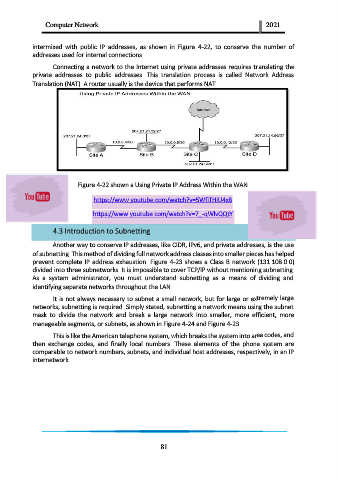
            intermixed  with  public  IP  addresses,  as  shown  in  Figure  4-22,  to  conserve  the  number  of
            addresses used for internal connections.

                   Connecting a network to the Internet using private addresses requires translating the
            private  addresses  to  public  addresses.  This  translation  process  is  called  Network  Address
            Translation (NAT). A router usually is the device that performs NAT.


                            Figure 4-22 shown a Using Private IP Address Within the WAN

                                  https://www.youtube.com/watch?v=5WfiTHiU4x8

                                  https://www.youtube.com/watch?v=7_-qWlvQQtY


                    4.3 Introduction to Subnetting

                   Another way to conserve IP addresses, like CIDR, IPv6, and private addresses, is the use
            of subnetting. This method of dividing full network address classes into smaller pieces has helped
            prevent complete IP address exhaustion. Figure 4-23 shows a Class B network (131.108.0.0)
            divided into three subnetworks. It is impossible to cover TCP/IP without mentioning subnetting.
            As  a  system  administrator,  you  must  understand  subnetting  as  a  means  of  dividing  and
            identifying separate networks throughout the LAN.

                   It is not always necessary to subnet a small network, but for large or extremely large
            networks, subnetting is required. Simply stated, subnetting a network means using the subnet
            mask  to  divide  the  network  and  break  a  large  network  into  smaller,  more  efficient,  more
            manageable segments, or subnets, as shown in Figure 4-24 and Figure 4-23.

                   This is like the American telephone system, which breaks the system into area codes, and
            then  exchange  codes,  and  finally  local  numbers.  These  elements  of  the  phone  system  are
            comparable to network numbers, subnets, and individual host addresses, respectively, in an IP
            internetwork.


                                                         81

