


Page 94 - Handout Computer Network.
P. 94
Chapter (3) Networking Media and Data Link Layers Protocols


                        A Class C address begins with binary 110. Therefore, the lowest number that can be
                represented is 11000000 (decimal 192), and the highest number that can be represented is
                11011111 (decimal 223). If an address contains a number in the range of 192 to 223 in the first
                octet, it is a Class C address.


                     4.2.3.4 Class D Addresses

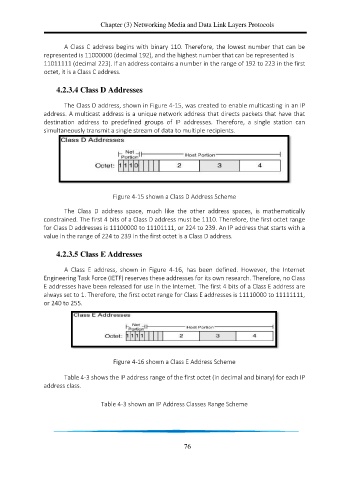
                        The Class D address, shown in Figure 4-15, was created to enable multicasting in an IP
                address. A multicast address is a unique network address that directs packets that have that
                destination  address  to  predefined  groups  of  IP  addresses.  Therefore,  a  single  station  can
                simultaneously transmit a single stream of data to multiple recipients.


                                         Figure 4-15 shown a Class D Address Scheme


                        The  Class  D  address  space,  much  like  the  other  address  spaces,  is  mathematically
                constrained. The first 4 bits of a Class D address must be 1110. Therefore, the first octet range
                for Class D addresses is 11100000 to 11101111, or 224 to 239. An IP address that starts with a
                value in the range of 224 to 239 in the first octet is a Class D address.


                     4.2.3.5 Class E Addresses

                        A  Class  E  address,  shown  in  Figure  4-16,  has  been  defined.  However,  the  Internet
                Engineering Task Force (IETF) reserves these addresses for its own research. Therefore, no Class
                E addresses have been released for use in the Internet. The first 4 bits of a Class E address are
                always set to 1. Therefore, the first octet range for Class E addresses is 11110000 to 11111111,
                or 240 to 255.


                                         Figure 4-16 shown a Class E Address Scheme

                        Table 4-3 shows the IP address range of the first octet (in decimal and binary) for each IP
                address class.


                                     Table 4-3 shown an IP Address Classes Range Scheme


                                                                  76

