


Page 28 - Digital Book Bilingual Perpindahan Kalor
P. 28
Conduction


                                                                Conduction  is  the  process  of
                                                                heat        transfer        through         a

                                                                substance without the movement
                                                                of its particles. Heat transfer by
                                                                conduction         occurs       in     solid

                                                                materials.


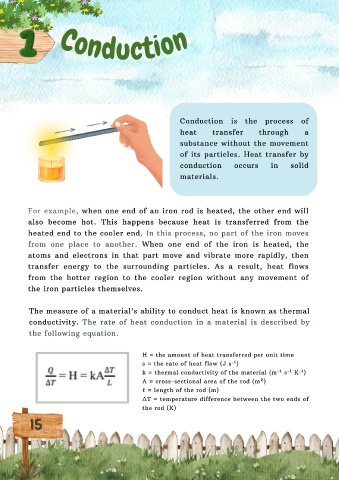
           For example, when one end of an iron rod is heated, the other end will

           also  become  hot.  This  happens  because  heat  is  transferred  from  the
           heated end to the cooler end. In this process, no part of the iron moves

           from  one  place  to  another.  When  one  end  of  the  iron  is  heated,  the
           atoms  and  electrons  in  that  part  move  and  vibrate  more  rapidly,  then
           transfer  energy  to  the  surrounding  particles.  As  a  result,  heat  flows

           from  the  hotter  region  to  the  cooler  region  without  any  movement  of
           the iron particles themselves.


           The measure of a material’s ability to conduct heat is known as thermal

           conductivity. The rate of heat conduction in a material is described by
           the following equation.


                                                   H = the amount of heat transferred per unit time
                                                   s = the rate of heat flow (J s⁻¹)
                                                   k = thermal conductivity of the material (m⁻¹ s⁻¹ K⁻¹)
                                                   A = cross-sectional area of the rod (m²)
                                                   ℓ = length of the rod (m)
                                                   ΔT = temperature difference between the two ends of
                                                   the rod (K)
            15

