


Page 36 - Future Stars Science Explorer-5
P. 36
the sound waves to a thin membrane called the eardrum. The eardrum
            vibrates (moves) very fast. These vibrations are passed on to the inner ear,

            and from there they are carried on to the brain through the auditory nerve.
            The brain then interrupts the message, and we are able to hear the sound.


            Nose

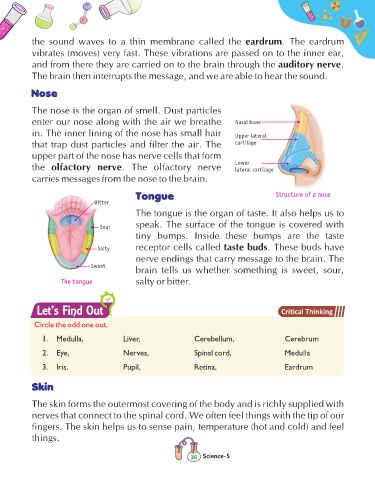
            The nose is the organ of smell. Dust particles

            enter our nose along with the air we breathe                          Nasal bone
            in. The inner lining of the nose has small hair                       Upper lateral

            that trap dust particles and filter the air. The                      cartilage
            upper part of the nose has nerve cells that form

            the  olfactory  nerve.  The  olfactory  nerve                         Lower
                                                                                  lateral cartilage
            carries messages from the nose to the brain.


                                                Tongue                                          Structure of a nose
                                  Bitter
                                                The tongue is the organ of taste. It also helps us to
                                                speak. The surface of the tongue is covered with
                                    Sour
                                                tiny  bumps.  Inside  these  bumps  are  the  taste

                                   Salty        receptor cells called taste buds. These buds have
                                                nerve endings that carry message to the brain. The

                                Sweet
                                                brain tells us whether something is sweet, sour,
                      The tongue                salty or bitter.


                                                                                                  Critical Thinking

             Circle the odd one out.

               1.   Medulla,                Liver,                  Cerebellum,                    Cerebrum


               2.   Eye,                    Nerves,                 Spinal cord,                   Medulla
               3.   Iris,                   Pupil,                  Retina,                        Eardrum


            Skin


            The skin forms the outermost covering of the body and is richly supplied with
            nerves that connect to the spinal cord. We often feel things with the tip of our

            fingers. The skin helps us to sense pain, temperature (hot and cold) and feel
            things.


                                                                   36  Science-5

