


Page 15 - The EDGE Fall 2025
P. 15
Fire Risers: A Critical Safety Mechanism for Buildings


          CONTINUED FROM PAGE 13

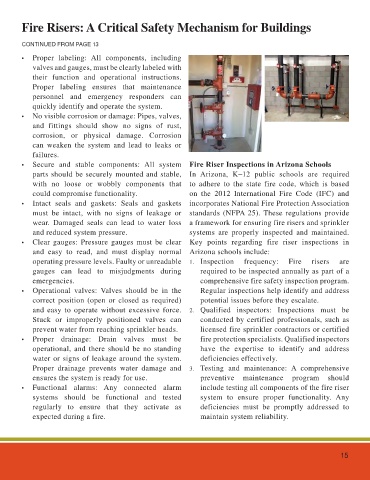
          •  Proper labeling:  All components, including
              valves and gauges, must be clearly labeled with
              their function and operational instructions.
              Proper labeling ensures that maintenance
              personnel and emergency responders can
              quickly identify and operate the system.
          •  No visible corrosion or damage: Pipes, valves,
              and  fittings  should  show  no  signs  of  rust,
              corrosion,  or physical damage.  Corrosion
              can weaken the system and lead to leaks or
              failures.
          •  Secure and stable components:  All system  Fire Riser Inspections in Arizona Schools
              parts should be securely mounted and stable,  In  Arizona,  K‒12  public  schools  are  required
              with no loose or wobbly components that  to adhere to the state fire code, which is based
              could compromise functionality.                    on the 2012 International Fire Code (IFC) and
          •  Intact seals and gaskets: Seals and gaskets  incorporates National Fire Protection Association
              must be intact, with no signs of leakage or  standards (NFPA 25). These regulations provide
              wear. Damaged seals can lead to water loss  a framework for ensuring fire risers and sprinkler
              and reduced system pressure.                       systems are properly inspected and maintained.
          •  Clear gauges: Pressure gauges must be clear  Key points regarding fire riser inspections in
              and easy to read, and must display normal  Arizona schools include:
              operating pressure levels. Faulty or unreadable    1.  Inspection     frequency:    Fire    risers   are
              gauges can lead to misjudgments during                 required to be inspected annually as part of a
              emergencies.                                           comprehensive fire safety inspection program.
          •  Operational valves:  Valves should be in the            Regular inspections help identify and address
              correct position (open or closed as required)          potential issues before they escalate.
              and easy to operate without excessive force.       2.  Qualified inspectors: Inspections must be
              Stuck or improperly positioned valves can              conducted by certified professionals, such as
              prevent water from reaching sprinkler heads.           licensed fire sprinkler contractors or certified
          •  Proper drainage: Drain valves must be                   fire protection specialists. Qualified inspectors
              operational, and there should be no standing           have the expertise to identify and address
              water or signs of leakage around the system.           deficiencies effectively.
              Proper drainage prevents water damage and          3.  Testing and maintenance:  A comprehensive
              ensures the system is ready for use.                   preventive maintenance program should
          •  Functional alarms:  Any connected alarm                 include testing all components of the fire riser
              systems should be functional and tested                system to ensure proper functionality.  Any
              regularly to ensure that they activate as              deficiencies must be promptly addressed to
              expected during a fire.                                maintain system reliability.


                                                                                                                   15

