


Page 16 - Hello Philippines January 2016 'B' issue
P. 16
16 www.hello-philippines.com NEWS January 2016 / Fortnightly – No. 2 • UK & Europe Edition
DSPEoCIAmL REePOsRtT ic workers face long road
to labor rights at home and abroad
MANILA – Remy Borlongan, 59,
left the Philippines in April 1986, a the need to form a union to respond to
couple of months after the Marcos
dictatorship was toppled. the various problems faced by workers
Her husband had met an accident in a foreign land.
while riding a motorcycle. Not only
was he unable to earn a living for their “Maraming police cases, tulad
family, debts were also piling up. So
even if it meant she had to leave their ng rape at ‘yung tinutulak pero
infant son for her husband and her in-
laws to raise, she followed her sisters papalabasing suicide. Merong pinlantsa
to Hong Kong, where she was to clean
house for a Chinese couple. ang mukha (There were a lot of police
She had steeled herself for the hard cases like rapes and those pushed off
work and the loneliness, but she wasn’t
prepared for the abuse. to their death from the high-rises but
Her first employers did not speak would be reported as suicides. There
English and she spoke neither Mandarin
nor Cantonese, so there was always were also those whose faces were
some misunderstanding about what
they wanted her to do. The turning burned with a hot iron),” she says.
point came several months later, when
her employers spent their vacation in Other common problems
Mainland China, leaving her locked for
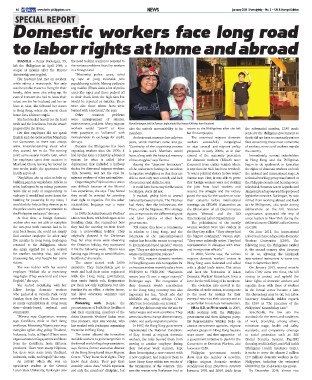
two weeks inside the apartment with were underpayment of salaries, Remy Borlongan (left) in Banaue. (right photo) Rex Varona ©Photos from Facebook
hardly any food.
maltreatment, and debt. Many migrant
“Naghihitsa ako ng sulat sa baba ng
building pag may nagdadaan. Sabi ko sa workers would “pawn” or leave also the union’s accountability to its return to the Philippines after she left the substantial number, C189 made
sulat, kailangan ko ng tulong, pumunta members. her first employers. sense for the Philippine government so
‘kako sila sa pulis at magsumbong sa their passports as “collateral” with that it did not have to constantly put out
embassy (I would hurl notes down the As their work contracts last only two The unionized migrant domestic fires concerning these most vulnerable
building for passersby. In my notes, I moneylenders in exchange for credit, years, union members come and go. workers successfully campaigned of workers, more so of workers outside
would ask for help, telling them to go to “Continuity of the organizing process to stop several anti-migrant policy the country.
the police and to report my situation to she says. is precarious work. Members would proposals in early 2000s, as in ther
the Philippine embassy),” she says. leave, along with the historical memory emoval of the maternity protection Immediately, various stakeholders
Because the Philippines has been of the struggles,” says Varona. for domestic workers (Editor’s note: in Hong Kong and the Philippines
At that time, a foreign domestic Corrected from earlier version where began to do spadework to formalize
worker who was not able to complete exporting workers since the 1970s, it Among the “objective limitations” it says that the NCS has been revoked). the rights of domestic workers on both
the two-year work contract had to be of the union were having the members “It was a political victory in two ways,” the national and international stage. A
sent back home; she could not simply had by that time a relatively advanced in separate workplaces so that they are Varona says. First, it was able to prove technical working group was formed at
find another employer. So after only able to meet only once a week, and lack that foreign workers were not stealing the Philippine Senate and hearings were
five months in Hong Kong, Borlongan system for what it called labor of resources and skills, he says. the jobs from local workers and scheduled. Senators Loren Legarda and
returned to the Philippines, where second, the struggle and the victory Jinggoy Estrada sponsored the proposed
she again applied for a job, waited deployment that included a halfway It could have been easy for the union paved the way for the workers to raise legislative measure. Borlongan, by now
for another working visa, paid the to collapse. But it did not. their concerns before international retired from working abroad and back
processing fee, and bought her plane shelter for distressed migrant workers. meetings on CEDAW (Convention on in the Philippines, also spoke during
tickets. It evolved, giving birth to several the Elimination of all Discrimination deliberations on the bill. Varona’s
This, however, was not the case for nationality-based unions. The Filipinos Against Women) and the ILO organization sponsored the trip of
She was luckier with her second had theirs, then the Indonesians, the (International Labor Organization). union leaders to New York during the
employer. “Mabait sila at marunong migrant workers of other nationalities. Thais, and the Nepalese. This strategy deliberations on CEDAW and to Geneva
mag-Ingles (They were kind and knew was a response to the different migrant The politicization of the mostly on C189.
English),” she says. Organizing the Filipinos into a union and labor policies of their home women workers were also evident in
governments. the May Day rallies. “They always had On June 2011, the International
She started socializing with her was difficult because of the Martial the biggest contingent,” Varona says. Labor Conference adopted the Domestic
fellow foreign domestic workers “Of course they have a community “They were politically active. They had Workers Convention (C189). The
who gathered at Victoria Park every Law experience, she says. They feared in relation to Hong Kong, and the representation in dialogues with labor following year, the Philippines ratified
Sunday, their day of rest. There were federation of the nationality-based and immigration officials.” it, the second country after Uruguay
so many organizations in Hong Kong they would be arrested for asserting unions has been the means to respond to do so, allowing the landmark
then—church-based, regional, and to international-based agenda,” Varona In 2000, Varona says, the various international instrument to come into
community. their right to organize. For the other says. “They are able to work together on migrant domestic workers’ unions in force in September 2013.
wages and immigration policies.” Hong Kong were federated and allied
“Merong mga Cagayanon, merong nationalities, language was a major with a global trade union. The union On January 2013, several months
taga Cordillera, mula sa iba’t ibang In 1992, migrant domestic workers and later the Federation of Asian before C189 came into force, the bill
probinsya. Maraming Pilipino, pero may obstacle. in Hong Kong were able to negotiate for Domestic Workers’ Union have been a aiming to protect and uphold the
mangilan-ngilan ding galing Thailand, an increase in their monthly salary from force for the well-being of its members. labor rights of domestic workers and
Indonesia, India, at Nepal (There were In 1989, the Asian Domestic Workers’ HK$1,900 to HK$3,200. “Naipanalo equalize them with those of workers
organizations for Cagayanons and those namin ‘yun (It was a major victory),” The evolution also moved in the in the formal sector became a law.
from the Cordillera, from different Union was born, with Borlongan as its Borlongan says. The recognition of direction of credit unions, as a response The chronology may be off, but Labor
provinces. There were many Filipinos, their domestic work’s contribution to the need for savings for their Secretary Rosalinda Baldoz regards
but there were some from Thailand, founding chair. She remembers how to the Hong Kong economy was also eventual return to their country and as the C189 as “the precursor of the
Indonesia, India, and Nepal),” she says. important for her. “Hindi nila dati a counterfoil to usurious moneylenders. Philippines’ Kasambahay Law.”
they had the meeting on New Year’s kinikilala ang aming serbisyo (They
An activist when she was an didn’t use to recognize our service).” HK to ILO, to PH to world. In 2009, Specifically, the law sets the
agriculture student at the Central Day, a non-working holiday. They while working with the Philippine standards for the terms and conditions
Luzon State University, Borlongan saw But they did not only win the war for government and then Akbayan party- of work, providing, among others,
originally planned it for Christmas better wages and work conditions. They list Representative Walden Bello on minimum wage, health and safety
were also able to change discriminatory, abusive recruitment agencies, migrant standards, and compulsory coverage
Day, but since many were observing unfair, and costly migration policies. workers groups in Hong Kong became to social protection such as SSS
more aware—and then supportive—of (Social Security System), Pag-IBIG
the Christian holiday, they postponed In 1987, the Hong Kong government a government initiative to push for the (housing credit facility), and PhilHealth
implemented the National Conditions Convention on Domestic Workers, also (Philippine Health Insurance Corp.).
it for the following week. “Meron kasi of Stay. Aimed at migrant domestic known as C189. It seeks to cover the almost 2 million
workers, the rules banned them from (1.9 million) domestic workers in the
kaming mga (Among us were) Muslim, moving to another employer during Philippine government records Philippines, including the estimated
their two-year work contract, kept show that the number of new-hire 600,000 in the 16-24 years age group.
Buddhists,” she recalls. them from signing a new contract with Filipino migrant domestic workers
a new employer, and required them to steadily rose from 260,000 to 330,000 By December 2014, almost two
The union started with 5,000 leave Hong Kong within two weeks of between 1992 and 2009. Aside from
the termination of the contract. This
members. They immediately got to was the reason why Borlongan had to
work and had their union registered
with the Hong Kong government,
then under British rule. Registration
got them not only legitimacy, but also
funding for an office, a shelter house,
and labor education seminars and
workshops.
Pioneering work. Despite the
precariousness of both their livelihood
and their organizing, members of the
Asian Domestic Workers’ Union were
true pioneers, says Rex Varona, who
has worked with Borlongan organizing
the union in Hong Kong.
The union allowed the heretofore
invisible workers to gain recognition in
the formal world of legal representation,
says Varona, former executive director
of the Hong Kong-based Asian Migrant
Centre. “They know their rights. They
know their duties. They pay their
monthly union dues,” which represent
not only the members’ discipline, but

