


Page 109 - M. Abrahim Thesis
P. 109
— Internetwork Packet Exchange (IPX)

            —    AppleTalk


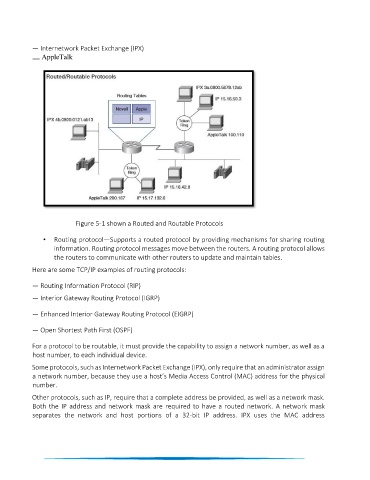
                          Figure 5-1 shown a Routed and Routable Protocols


               •  Routing protocol—Supports a routed protocol by providing mechanisms for sharing routing
                   information. Routing protocol messages move between the routers. A routing protocol allows
                   the routers to communicate with other routers to update and maintain tables.

            Here are some TCP/IP examples of routing protocols:

            — Routing Information Protocol (RIP)

            — Interior Gateway Routing Protocol (IGRP)

            — Enhanced Interior Gateway Routing Protocol (EIGRP)

            — Open Shortest Path First (OSPF)


            For a protocol to be routable, it must provide the capability to assign a network number, as well as a
            host number, to each individual device.

            Some protocols, such as Internetwork Packet Exchange (IPX), only require that an administrator assign
            a network number, because they use a host’s Media Access Control (MAC) address for the physical
            number.
            Other protocols, such as IP, require that a complete address be provided, as well as a network mask.
            Both the IP address and network mask are required to have a routed network. A network mask
            separates  the  network  and  host  portions  of  a  32-bit  IP  address.  IPX  uses  the  MAC  address

