


Page 20 - M. Abrahim Thesis
P. 20
Chapter (2) Network Fundamental and Layered Network Architecture


                 2.3   Network Protocols

                        Protocol suites are collections of protocols that enable network communication from
                one host through the network to another host. A protocol is a formal description of a set of rules
                and conventions that govern a particular aspect of how devices on a network communicate.
                Protocols determine the format, timing, sequencing, and error control in data communication.
                Without protocols, the computer cannot create or rebuild the stream of incoming bits from
                another computer into the original data. Protocols control all aspects of data communication.
                They determine how the physical network is built, how computers connect to the network, how
                the data is formatted for transmission, and how that data is sent.
                        These network rules are created and maintained by many different organizations and
                committees:

                        •  Institute of Electrical and Electronic Engineers (IEEE)
                        •  American National Standards Institute (ANSI)
                        •  Telecommunications Industry Association (TIA)

                        •  Electronic Industries Alliance (EIA)
                        •  International Telecommunications Union (ITU), formerly known as the CCITT (Comité
                           Consultatif International Téléphonique et Télégraphique).

                        •  https://www.youtube.com/watch?v=P6SZLcGE4us

                 2.4   Network Based on Coverage Area

                2.4.1 Local-Area Networks (LANs)

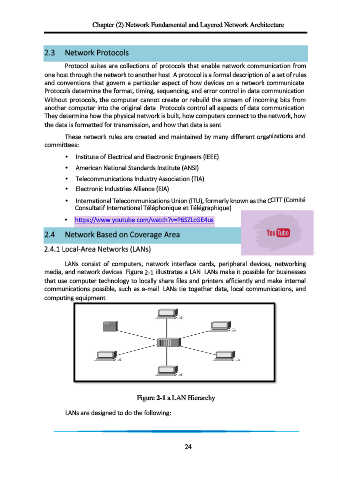
                        LANs  consist  of  computers,  network  interface  cards,  peripheral  devices,  networking
                media, and network devices. Figure 2-1 illustrates a LAN. LANs make it possible for businesses
                that use computer technology to locally share files and printers efficiently and make internal
                communications possible, such as e-mail. LANs tie together data, local communications, and
                computing equipment.


                                                 Figure  2 - 1  a LAN Hierarchy

                        LANs are designed to do the following:


                                                                  24

