


Page 26 - M. Abrahim Thesis
P. 26
Chapter (2) Network Fundamental and Layered Network Architecture


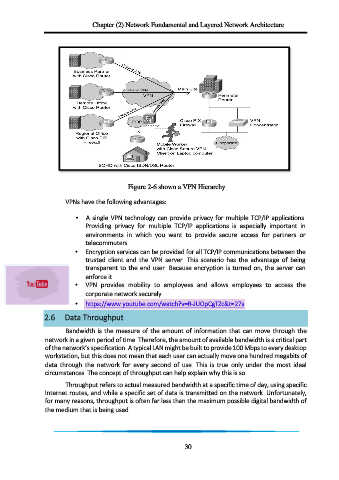
                                              Figure  2 - 6  shown a VPN Hierarchy

                        VPNs have the following advantages:

                           •  A single VPN technology can provide privacy for multiple TCP/IP applications.
                               Providing  privacy  for  multiple  TCP/IP  applications  is  especially  important  in
                               environments  in  which  you  want  to  provide  secure  access  for  partners  or
                               telecommuters.
                           •  Encryption services can be provided for all TCP/IP communications between the
                               trusted  client  and  the  VPN  server.  This  scenario  has  the  advantage  of  being
                               transparent to the end user. Because encryption is turned on, the server can
                               enforce it.
                           •  VPN  provides  mobility  to  employees  and  allows  employees  to  access  the
                               corporate network securely.
                           •  https://www.youtube.com/watch?v=R-JUOpCgTZc&t=27s

                 2.6   Data Throughput

                        Bandwidth is the measure of the amount of information that can move through the
                network in a given period of time. Therefore, the amount of available bandwidth is a critical part
                of the network’s specification. A typical LAN might be built to provide 100 Mbps to every desktop
                workstation, but this does not mean that each user can actually move one hundred megabits of
                data  through  the  network  for  every  second  of  use.  This  is  true  only  under  the  most  ideal
                circumstances. The concept of throughput can help explain why this is so.

                        Throughput refers to actual measured bandwidth at a specific time of day, using specific
                Internet routes, and while a specific set of data is transmitted on the network. Unfortunately,
                for many reasons, throughput is often far less than the maximum possible digital bandwidth of
                the medium that is being used.


                                                                  30

