


Page 11 - RJLMS - Legacy Program Purple
P. 11
Black Liberation  Presidential Campaigns


            Politics that Paved a New American Way


 ith an ever-widening list of demands for his   ith a growing national and international profile and platform, Rev. Jackson—tireless and resolute—set out to
 Wsupport, Jackson left the SCLC organization   Wbring about even more ambitious change, running twice for president of the United States. Both campaigns
 to start PUSH (People United to Save-later Serve-  broke new ground in U.S. politics. He became the first Black person to win a major party’s state primary or caucus,
 Humanity), born on Christmas Day in 1971 at the Met   a feat unmatched until Barack Obama did so in 2008.
 Theatre, with 5,000 people in attendance. In between
 Breadbasket’s cessation and PUSH’s creation, Jackson   Before Jackson considered a run for the White House,
 launched the Black Expo to highlight what he called   in 1982, he helped thousands of Black and Brown
 Black Excellence. The highly attended event was held at   Chicagoans campaigning for Congressman Harold
 the old Amphitheater on 42nd and Halsted.  Washington. In 1983, “We Shall See in 83’” was the
            theme for Washington’s victory that April. This led to
 Billed at the time as the largest Black showcase of its   opening up the door for young activists and organizers
 kind in America with one million people attending   to win elected seats across the country, according to Dr.
 the five-day event at the Amphitheater, the Black Expo   Rev. Otis Moss, Jr.
 featured top artists from Motown, Stax Records, and
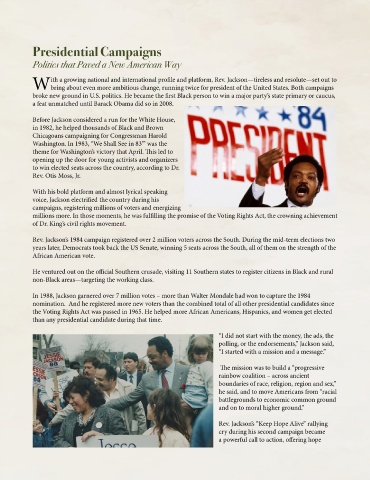
 Buddha labels nightly (as seen in the movie, “Save    With his bold platform and almost lyrical speaking
 The Children”).  voice, Jackson electrified the country during his
            campaigns, registering millions of voters and energizing
 Rev. Jackson’s success in mobilizing and spurring people   millions more. In those moments, he was fulfilling the promise of the Voting Rights Act, the crowning achievement
 to action emboldened him, and in much the same   of Dr. King’s civil rights movement.
 way his mother’s community work had done for her.
 In 1984, he founded the National Rainbow Coalition,   Rev. Jackson’s 1984 campaign registered over 2 million voters across the South. During the mid-term elections two
 a social justice organization based in Washington,   years later, Democrats took back the US Senate, winning 5 seats across the South, all of them on the strength of the
 D.C, devoted to political empowerment, education,   African American vote.
 and changing public policy. In September of 1996, the
 Rainbow Coalition and Operation PUSH merged to   He ventured out on the official Southern crusade, visiting 11 Southern states to register citizens in Black and rural
 form the Rainbow PUSH Coalition, continuing the   non-Black areas—targeting the working class.
 work of both organizations and maximizing resources.
            In 1988, Jackson garnered over 7 million votes – more than Walter Mondale had won to capture the 1984
 The National Black Convention was held in Gary,   nomination.  And he registered more new voters than the combined total of all other presidential candidates since
 Indiana. Mayor Hatcher worked closely with Reverend   the Voting Rights Act was passed in 1965. He helped more African Americans, Hispanics, and women get elected
 Jackson to bring prominent Black leaders from around   than any presidential candidate during that time.
 the world.
                                                                         “I did not start with the money, the ads, the
 A visionary who could be extraordinarily prophetic,                     polling, or the endorsements,” Jackson said,
 Rev. Jackson advocated for national health care, a                      “I started with a mission and a message.”
 war on drugs, direct peace negotiations between
 Palestinians and Israelis, ending apartheid in South                     The mission was to build a “progressive
 Africa, and advancing democracy in Haiti, all before                    rainbow coalition – across ancient
 they became accepted public policy positions. His work                  boundaries of race, religion, region and sex,”
 helped bring the American public to a new level of civil                he said, and to move Americans from “racial
 and social consciousness. And he was only                               battlegrounds to economic common ground
 getting started.                                                        and on to moral higher ground.”

                                                                         Rev. Jackson’s “Keep Hope Alive” rallying
                                                                         cry during his second campaign became
                                                                         a powerful call to action, offering hope

