


Page 13 - RJLMS - Legacy Program Purple
P. 13
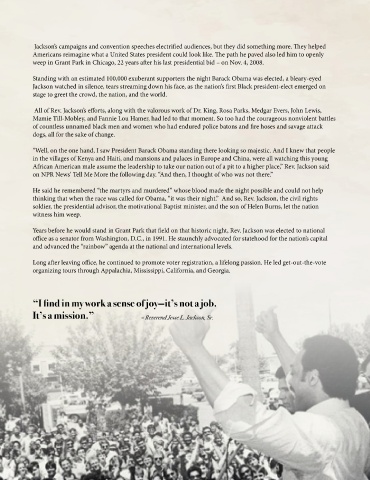
to those in despair and prompting the weary to remain    Jackson’s campaigns and convention speeches electrified audiences, but they did something more. They helped
 engaged in the political process.   Americans reimagine what a United States president could look like. The path he paved also led him to openly
            weep in Grant Park in Chicago, 22 years after his last presidential bid – on Nov. 4, 2008.
 Rev. Jackson’s campaigns also opened the door for new
 leadership to emerge. After the 1988 campaign came   Standing with an estimated 100,000 exuberant supporters the night Barack Obama was elected, a bleary-eyed
 even more breakthroughs:  the first African American   Jackson watched in silence, tears streaming down his face, as the nation’s first Black president-elect emerged on
 Mayors of New York City, Seattle, and Durham, the first   stage to greet the crowd, the nation, and the world.
 African American Governor of Virginia, the election of
 the 88 Minnesota co-chair Paul Wellstone and Vermont’s    All of Rev. Jackson’s efforts, along with the valorous work of Dr. King, Rosa Parks, Medgar Evers, John Lewis,
 Bernie Sanders to the US Senate, as well as the first African   Mamie Till-Mobley, and Fannie Lou Hamer, had led to that moment. So too had the courageous nonviolent battles
 American woman in the US Senate, Carol Mosely Braun.   of countless unnamed black men and women who had endured police batons and fire hoses and savage attack
 Also, after his campaigns, minority members of the US   dogs, all for the sake of change.
 House of Representatives doubled in size between 1990
 and 1992.  “Well, on the one hand, I saw President Barack Obama standing there looking so majestic. And I knew that people
            in the villages of Kenya and Haiti, and mansions and palaces in Europe and China, were all watching this young
 Barack Obama said Jackson’s campaigns awakened him to what was possible, and that the election rule changes   African American male assume the leadership to take our nation out of a pit to a higher place,” Rev. Jackson said
 Jackson forced were critical to his winning the Democratic nomination in 2012.  on NPR News’ Tell Me More the following day. “And then, I thought of who was not there.”

 Impressed with his vision for America, then-Mayor Bernie Sanders of Vermont endorsed Rev. Jackson during a   He said he remembered “the martyrs and murdered” whose blood made the night possible and could not help
 speech to a packed auditorium in Burlington in April 1988. The mayor praised Rev. Jackson as “a candidate for   thinking that when the race was called for Obama, “it was their night.”  And so, Rev. Jackson, the civil rights
 president who has done more than any other candidate in living memory to bring together the disenfranchised.”   soldier, the presidential advisor, the motivational Baptist minister, and the son of Helen Burns, let the nation
 He called him “a candidate who is creating a historic coalition, of working people, of poor people, of women, of   witness him weep.
 minorities, of students, of farmers, of peace advocates, of environmentalists” and “a man who has waged the most
 courageous and exciting political campaign in the modern history of our nation.”  Years before he would stand in Grant Park that field on that historic night, Rev. Jackson was elected to national
            office as a senator from Washington, D.C., in 1991. He staunchly advocated for statehood for the nation’s capital
 Rev. Jackson capped his runs for president by delivering   and advanced the “rainbow” agenda at the national and international levels.
 rousing speeches at both the 1984 and 1998 Democratic
 National Conventions. His orations at the conventions are   Long after leaving office, he continued to promote voter registration, a lifelong passion. He led get-out-the-vote
 regarded as among the greatest speeches in    organizing tours through Appalachia, Mississippi, California, and Georgia.
 American politics.


 During his 1984 address, the Baptist minister thundered
 that, “America is not like a blanket — one piece of   “I find in my work a sense of joy—it’s not a job.
 unbroken cloth, the same color, the same texture, the same   It’s a mission.”
 size.”  To a rapt audience, he continued, “America is more   – Reverend Jesse L. Jackson, Sr.
 like a quilt: many patches, many pieces, many colors, many
 sizes, all woven and held together by a common thread.
 The white, the Hispanic, the black, the Arab, the Jew,
 the woman, the native American, the small farmer, the
 businessperson, the environmentalist, the peace activist,
 the young, the old, the lesbian, the gay, and the disabled
 make up the American quilt.”


 As with many prophetic moments during his life, Rev.
 Jackson’s remarks also warned of the perils of divisiveness,
 which are just as resonant today.  “Even in our fractured
 state, all of us count and fit somewhere. We have proven
 that we can survive without each other. But we have not
 proven that we can win and make progress without each
 other. We must come together.”

